

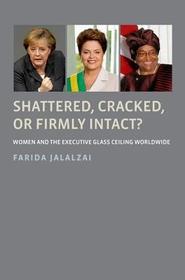
Shattered, Cracked, or Firmly Intact?
Women and the Executive Glass Ceiling Worldwide
- Publisher's listprice GBP 30.49
-
14 566 Ft (13 872 Ft + 5% VAT)
The price is estimated because at the time of ordering we do not know what conversion rates will apply to HUF / product currency when the book arrives. In case HUF is weaker, the price increases slightly, in case HUF is stronger, the price goes lower slightly.
- Discount 10% (cc. 1 457 Ft off)
- Discounted price 13 109 Ft (12 485 Ft + 5% VAT)
Subcribe now and take benefit of a favourable price.
Subscribe
14 566 Ft

Availability
printed on demand
Why don't you give exact delivery time?
Delivery time is estimated on our previous experiences. We give estimations only, because we order from outside Hungary, and the delivery time mainly depends on how quickly the publisher supplies the book. Faster or slower deliveries both happen, but we do our best to supply as quickly as possible.
Product details:
- Publisher OUP USA
- Date of Publication 28 April 2016
- ISBN 9780190602093
- Binding Paperback
- No. of pages324 pages
- Size 229x157x22 mm
- Weight 454 g
- Language English 0
Categories
Short description:
In the past 50 years, fewer than eighty women worldwide have attained the office of prime minister or president. In 2010, women held just seventeen of the world's 252 executive posts - slightly less than seven percent. In Shattered, Cracked, or Firmly Intact?, Farida Jalalzai explores the patterns of women executives' paths, powers, and potential impacts, examining the global and national mechanisms that prevent women from attaining executive office.
MoreLong description:
How do men's and women's paths to political office differ? Once in office, are women's powers more constrained than those of men?
The number of women in executive leadership positions has grown substantially over the past five decades, and women now govern in vastly different contexts around the world. But their climbs to such positions don't necessarily correspond with social status and the existence of gender equity.
In Shattered, Cracked, or Firmly Intact? Farida Jalalzai outlines important patterns related to women executive's paths, powers, and potential impacts. In doing so, she combines qualitative and quantitative analysis and explores both contexts in which women successfully gained executive power and those in which they did not.
The glass ceiling has truly shattered in Finland (where, to date, three different women have come to executive power), only cracked in the United Kingdom (with Margaret Thatcher as the only example of a female prime minister), and remains firmly intact in the United States. While women appear to have made substantial gains, they still face many obstacles in their pursuit of national executive office. Women, compared to their male counterparts, more often ascend to relatively weak posts and gain offices through appointment as opposed to popular election. When dominant women presidents do rise through popular vote, they still almost always hail from political families and from within unstable systems. Jalalzai asserts the importance of institutional features in contributing positive representational effects for women national leaders. Her analysis offers both a broad understanding of global dynamics of executive power as well as particulars about individual women leaders from every region of the globe over the past fifty years. Viewing gender as embedded within institutions and processes, this book provides an unprecedented and comprehensive view of the complex, contradictory, and multifaceted dimensions of women's national leadership.
This is an outstanding book. Exhaustively researched, encyclopedic in scope, and elegantly written, Shattered, Cracked, or Firmly Intact? provides insights into the comparative study of gender and leadership in a way that is certain to catapult Farida Jalalzai into the forefront of gender studies and leadership studies.
Table of Contents:
Acknowledgments
1 Introduction
2 Women Executives: The Literature
3 Women Executives: Positions, Selections, Systems, and Powers
4 A More In-Depth Analysis of Executive Positions and Paths
5 General Backgrounds of Women Leaders
6 Specific Pathways to Power: Political Families and Activism
7 A Statistical Analysis of Women's Rule
8 An Overview of Female Presidential Candidacies
9 Close but Not Close Enough: The Historic Candidacies of Hillary Clinton and Ségolène Royal
10 Conclusions on Women Executives and Directions for Future Research
Appendix: Bibliographies of Women Leaders, 1960-2010
Notes
References
Index

