

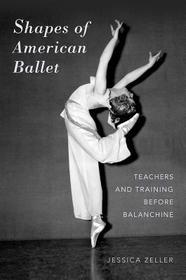
Shapes of American Ballet
Teachers and Training before Balanchine
- Publisher's listprice GBP 150.00
-
67 725 Ft (64 500 Ft + 5% VAT)
The price is estimated because at the time of ordering we do not know what conversion rates will apply to HUF / product currency when the book arrives. In case HUF is weaker, the price increases slightly, in case HUF is stronger, the price goes lower slightly.
- Discount 10% (cc. 6 773 Ft off)
- Discounted price 60 953 Ft (58 050 Ft + 5% VAT)
Subcribe now and take benefit of a favourable price.
Subscribe
67 725 Ft

Availability
printed on demand
Why don't you give exact delivery time?
Delivery time is estimated on our previous experiences. We give estimations only, because we order from outside Hungary, and the delivery time mainly depends on how quickly the publisher supplies the book. Faster or slower deliveries both happen, but we do our best to supply as quickly as possible.
Product details:
- Publisher OUP USA
- Date of Publication 4 August 2016
- ISBN 9780190296681
- Binding Hardback
- No. of pages216 pages
- Size 160x239x17 mm
- Weight 445 g
- Language English
- Illustrations 25 photographs 0
Categories
Short description:
Shapes of American Ballet introduces several lesser-known European and Russian ballet teachers who worked in New York City before Balanchine. Taking into account the effects of America's economic system and the early twentieth century popular stage, this book looks anew at American ballet as derived from multiple influences and lineages.
MoreLong description:
In Shapes of American Ballet: Teachers and Training before Balanchine, Jessica Zeller introduces the first few decades of the twentieth century as an often overlooked, yet critical period for ballet's growth in America. While George Balanchine is often considered the sole creator of American ballet, numerous European and Russian émigrés had been working for decades to build a national ballet with an American identity. These pedagogues and others like them played critical yet largely unacknowledged roles in American ballet's development. Despite their prestigious ballet pedigrees, the dance field's exhaustive focus on Balanchine has led to the neglect of their work during the first few decades of the century, and in this light, this book offers a new perspective on American ballet during the period immediately prior to Balanchine's arrival. Zeller uses hundreds of rare archival documents to illuminate the pedagogies of several significant European and Russian teachers who worked in New York City. Bringing these contributions into the broader history of American ballet recasts American ballet's identity as diverse-comprised of numerous Euro-Russian and American elements, as opposed to the work of one individual.
This new account of early twentieth century American ballet is situated against a bustling New York City backdrop, where mass immigration through Ellis Island brought the ballet from European and Russian opera houses into contact with a variety of American forms and sensibilities. Ballet from celebrated Euro-Russian lineages was performed in vaudeville and blended with American popular dance styles, and it developed new characteristics as it responded to the American economy. Shapes of American Ballet delves into ballet's struggle to define itself during this rich early twentieth century period, and it sheds new light on ballet's development of an American identity before Balanchine.
At last we've a serious examination by Jessica Zeller of seven brave and resourceful ballet teachers from Russia and Italy who came here to initiate and catalyze their ballet traditions. It's been a missing link in studies of the major influences on the creation of our unique, contemporary American ballet. Located in New York City, their schools tempered and molded both the athletic bodies of Americans, and in so doing affected the bold choreography of our artists. Zeller's fluid and judicious writing brings to light the energy and pathos of early twentieth century dance history.
Table of Contents:
Dedication
Acknowledgments
Introduction
Part I: Historical Perspectives
1. Ballet as Migrant: From Italy and Russia to America
2. Themes of Heterogeneity and Pluralism: Ballet in New York City, 1909-1934
3. Ballet in America: Coming of Age in a Market Economy
Part II: Teachers and Training
4. Ballet's Traditionalists: Malvina Cavallazzi and Luigi Albertieri
5. Nostalgic Revisionists: Stefano Mascagno and Mikhail Mordkin
6. Pragmatic Revisionists: Veronine Vestoff, Sonia Serova, and Louis H. Chalif
Conclusion
Selected Bibliography
Index

