

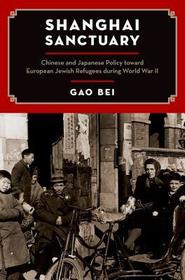
Shanghai Sanctuary
Chinese and Japanese Policy toward European Jewish Refugees during World War II
- Publisher's listprice GBP 35.99
-
16 249 Ft (15 475 Ft + 5% VAT)
The price is estimated because at the time of ordering we do not know what conversion rates will apply to HUF / product currency when the book arrives. In case HUF is weaker, the price increases slightly, in case HUF is stronger, the price goes lower slightly.
- Discount 10% (cc. 1 625 Ft off)
- Discounted price 14 624 Ft (13 928 Ft + 5% VAT)
Subcribe now and take benefit of a favourable price.
Subscribe
16 249 Ft

Availability
printed on demand
Why don't you give exact delivery time?
Delivery time is estimated on our previous experiences. We give estimations only, because we order from outside Hungary, and the delivery time mainly depends on how quickly the publisher supplies the book. Faster or slower deliveries both happen, but we do our best to supply as quickly as possible.
Product details:
- Publisher OUP USA
- Date of Publication 27 October 2016
- ISBN 9780190491581
- Binding Paperback
- No. of pages198 pages
- Size 231x155x12 mm
- Weight 318 g
- Language English 0
Categories
Short description:
Shanghai Sanctuary assesses the plight of the European Jewish refugees who fled to Japanese-occupied China during the Second World War. It is the first major study to examine the Nationalist government's policy towards the Jewish refugee issue and the most thorough and subtle analysis of Japanese diplomacy concerning this matter.
MoreLong description:
When the world closed its borders to desperate Jews fleeing Europe during World War II, Shanghai became an unexpected last haven for the refugees. An open port that could be entered without visas, this unique city under Western and Japanese control sheltered tens of thousands of Jews. Shanghai Sanctuary is the first major study to examine the Chinese Nationalist government's policy towards the "Jewish issue" as well as the most thorough analysis of how this issue played into Japanese diplomacy. Why did Shanghai's German-allied Japanese occupiers permit this influx of Jewish refugees? Gao illuminates how the refugees' position complicated the relationships between China, Japan, Germany, and the United States before and during World War II. She thereby reveals a great deal about the Great Powers' national priorities, their international agendas, and their perceptions of the global balance of power.
Drawing from both Chinese and Japanese archival sources that no Western scholar has been able to fully use before, Gao tells a rich story about the politics and personalities that brought Jewish refugees into Shanghai. This story, far from being a mere sidebar to the history of modern China and Japan, captures a critical moment when opportunistic authorities in both countries used the incoming Jewish refugees as a tool to win international financial and political support in their war against one another. Shanghai Sanctuary underlines the extent of Holocaust's global repercussions. In the process, the book sheds new light on the intricacies of wartime diplomacy and the far-reaching human consequences of the twentieth century's most documented conflict.
Basing her work on documents from American, Chinese, Japanese, and Taiwanese archives, Gao follows a clearly innovative approach that offers a dual reading of the policies and practices of the Nationalist Chinese government, on the one hand, and the Japanese government and military forces in occupied Manchuria and China, on the other... Gao's book...provid[es] us with a rich archival documentation that, still today, remains relatively
unexplored, makes an undeniable contribution to a larger, more up-to-date awareness of
the topic.
Table of Contents:
Acknowledgments
Introduction
1. Chinese and Japanese Perceptions of the Jews
2. The Chinese Nationalist Government and the Shanghai Jewish Refugees
3. Yasue Norihiro, Inuzuka Koreshige, and Japan's Policy toward the Shanghai Jewish Refugees, December 1937- December 1939
4. The Tripartite Pact and Japan's Policy toward the Shanghai Jewish Refugee Issue, January 1940-August 1945
Epilogue: The European Jewish Refugees and Shanghai
Notes
Bibliography
Index

