

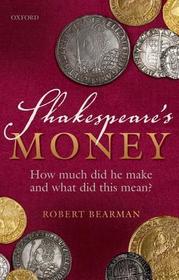
Shakespeare's Money
How much did he make and what did this mean?
- Publisher's listprice GBP 21.99
-
9 928 Ft (9 455 Ft + 5% VAT)
The price is estimated because at the time of ordering we do not know what conversion rates will apply to HUF / product currency when the book arrives. In case HUF is weaker, the price increases slightly, in case HUF is stronger, the price goes lower slightly.
- Discount 10% (cc. 993 Ft off)
- Discounted price 8 935 Ft (8 510 Ft + 5% VAT)
Subcribe now and take benefit of a favourable price.
Subscribe
9 928 Ft

Availability
printed on demand
Why don't you give exact delivery time?
Delivery time is estimated on our previous experiences. We give estimations only, because we order from outside Hungary, and the delivery time mainly depends on how quickly the publisher supplies the book. Faster or slower deliveries both happen, but we do our best to supply as quickly as possible.
Product details:
- Publisher OUP Oxford
- Date of Publication 5 April 2018
- ISBN 9780198822240
- Binding Paperback
- No. of pages208 pages
- Size 216x140x12 mm
- Weight 276 g
- Language English
- Illustrations 7 black-and-white halftones 0
Categories
Short description:
Shakespeare's Money explores what archival records can reveal about Shakespeare's economic and social success, shedding light on how he elevated his family from lowly status to minor gentry and how economic concerns were ever present in his daily life.
MoreLong description:
There is no doubting Shakespeare's literary genius, immortalised in his published work. However, statements along these lines are frequently followed by laments of how little is known about this life. This is true if we wish to know about Shakespeare's movements on even a month-by-month basis, or about his working practices and relationships with his theatrical fellows. However, too great an emphasis on this dearth of material not only leads to ill-informed comment that this is somehow 'suspicious' but also tends to downgrade the importance of what material has survived, often dismissed instead simply as evidence of his business dealings which have little bearing on his creative work. However, this material does at least help us to evaluate how successful Shakespeare was in earning a living in a profession which, in his day, was far from mainstream. By calculating his income from theatrical sources and exploring how this affected his financial circumstances and his ability to invest for his and his family's security, we can come to a better understanding of his social standing at different periods in his life, the most obvious evidence to his late sixteenth- and early seventeenth-century contemporaries of his success. Shakespeare undoubtedly died a man of comfortable means, but, as this book demonstrates, there is little to justify claims that he died possessed of great wealth. The circumstances of his daughters' marriages are a sufficient indication that he had not achieved true gentlemanly status. Other evidence suggests that he had not broken convincingly into the ranks of leading figures even of a small market town. Moreover, following a period of increasing prosperity, these 'business records' also reflect a declining income during the last ten years or so of his life and of his efforts to safeguard his assets. On the other hand, when compared with his father's business failure, mainly the result of a loss of credit, it is clear that, consciously or unconsciously, Shakespeare had the good sense or foresight not to over-reach himself.
In this sober, careful, and ruthlessly factual little book Robert Bearman provides a low-keyed but devastating correction to a great deal of airy assertion and sloppy scholarship produced by Shakespeare's biographers, ancient and modern. Bearman politely makes his case without naming the scholars he is correcting, but the urbanity of his performance does not detract from its potency ... This book offers a closely reasoned analysis of such hard data as exists and its conclusions will be difficult to dispute. Future biographers will ignore it at their peril.
Table of Contents:
List of Illustrations
Introduction
Early Life
Laying the foundations
Consolidation
Retrenchment
The final count
Conclusion
Works cited
Index

