

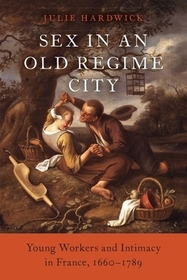
Sex in an Old Regime City
Young Workers and Intimacy in France, 1660-1789
- Publisher's listprice GBP 33.99
-
15 346 Ft (14 615 Ft + 5% VAT)
The price is estimated because at the time of ordering we do not know what conversion rates will apply to HUF / product currency when the book arrives. In case HUF is weaker, the price increases slightly, in case HUF is stronger, the price goes lower slightly.
- Discount 10% (cc. 1 535 Ft off)
- Discounted price 13 811 Ft (13 154 Ft + 5% VAT)
Subcribe now and take benefit of a favourable price.
Subscribe
15 346 Ft

Availability
printed on demand
Why don't you give exact delivery time?
Delivery time is estimated on our previous experiences. We give estimations only, because we order from outside Hungary, and the delivery time mainly depends on how quickly the publisher supplies the book. Faster or slower deliveries both happen, but we do our best to supply as quickly as possible.
Product details:
- Publisher OUP USA
- Date of Publication 6 October 2020
- ISBN 9780190945183
- Binding Hardback
- No. of pages294 pages
- Size 239x155x27 mm
- Weight 544 g
- Language English
- Illustrations 4 halftones 43
Categories
Short description:
Sex in an Old Regime City is a major reframing of the long history of young people's intimacy. It shows how long- running problems like out-of-wedlock pregnancy were handled very differently in Old Regime France than in more recent centuries. Abortion, infanticide, broken hearts, and conflict with parents and neighbors were key challenges of young people's lives then as now but young couples' efforts to deal with these challenges were supported in pragmatic, often sympathetic, ways by their communities and institutions like local courts, clergy, legal officials, and social welfare managers.
MoreLong description:
Our ideas about the long histories of young couples' relationships and women's efforts to manage their reproductive health are often premised on the notion of a powerful sexual double standard.
In Sex in an Old Regime City, Julie Hardwick offers a major reframing of the history of young people's intimacy. Based on legal records from the city of Lyon, Hardwick uncovers the relationships of young workers before marriage and after pregnancy occurred, even if marriage did not follow, and finds that communities treated these occurrences without stigmatizing or moralizing. She finds a hidden world of strategies young couples enacted when they faced an untimely pregnancy. If they could not or would not marry, they sometimes tried to terminate pregnancies, to make the newborn go away by a variety of measures, or to charge the infant to local welfare institutions. Far from being isolated, couples drew on the resources of local communities and networks. Clerics, midwives, wet nurses, landladies, lawyers, parents, and male partners in and outside the city offered pragmatic, sympathetic ways to help young, unmarried pregnant women deal with their situations and hold young men responsible for the reproductive consequences of their sexual activity. This was not merely emotional work; those involved were financially compensated. These support systems ensured that the women could resume their jobs and usually marry later, without long-term costs. In doing so, communities managed and minimized the disruptions and consequences even of cases of abandonment and unprosecuted infanticide.
This richly textured study re-thinks the ways in which fundamental issues of intimacy and gendered power were entwined with families, communities, and religious and secular institutions at all levels from households to neighborhoods to the state.
In a monograph that now appears on many course syllabi, Hardwick uncovers how women in early modern Lyon took charge of their sexual and reproductive lives with much community support. The scope of the book pertains to "young urban workers"...The book makes bold contributions to contemporary conversations about gender violence and abortion. U.S. Supreme Court Justice Samuel Alito, in the recent Dobbs decision, drew on seventeenth century barrister Matthew Hale's writings to claim that "an unbroken tradition of prohibiting abortion on pain of criminal punishment" had "persisted from the earliest days of the common law until 1973." Hardwick takes her readers across the channel and behind the law's normative façade to show how popular urban mores contrasted with such interdictions and how extensive early modern women's bodily autonomy could be.
Table of Contents:
Acknowledgments
Introduction A Foundling's Garter and the World of Young People's Intimacy
Ch.. 1. Sourcing Intimate Histories: The Social World of Young Workers
Ch. 2. Peril Stories: Licit Intimacy, Space, and Community Safeguarding
Ch. 3. Holding Men Responsible: Fertility, Community, and Court
Ch. 4. "Remedies" and Remedies: Managing Out-of-Wedlock Pregnancy
Ch. 5. Intimate Labor: Paid Work and an Intimate Economy of Reproduction
Ch. 6. Foundlings and Makeshift Coffins: Community Complicity and Dead Babies
Conclusion: The End of the Old Regime?
Notes
Bibliography
Index

