

- Publisher's listprice GBP 127.50
-
57 566 Ft (54 825 Ft + 5% VAT)
The price is estimated because at the time of ordering we do not know what conversion rates will apply to HUF / product currency when the book arrives. In case HUF is weaker, the price increases slightly, in case HUF is stronger, the price goes lower slightly.
- Discount 10% (cc. 5 756 Ft off)
- Discounted price 51 810 Ft (49 343 Ft + 5% VAT)
Subcribe now and take benefit of a favourable price.
Subscribe
57 566 Ft

Availability
printed on demand
Why don't you give exact delivery time?
Delivery time is estimated on our previous experiences. We give estimations only, because we order from outside Hungary, and the delivery time mainly depends on how quickly the publisher supplies the book. Faster or slower deliveries both happen, but we do our best to supply as quickly as possible.
Product details:
- Publisher OUP Oxford
- Date of Publication 26 March 2009
- ISBN 9780198204763
- Binding Hardback
- No. of pages698 pages
- Size 241x165x40 mm
- Weight 1196 g
- Language English
- Illustrations 16 black and white plates, 6 line drawings 0
Categories
Short description:
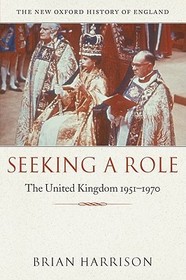
An impressively detailed but also unusually wide-ranging analysis of post-war Britain in the 1950s and 60s, covering everything from international relations to family life, the countryside to manufacturing, religion to race, cultural life to political structures.
MoreLong description:
In this, the first of two self-standing volumes bringing The New Oxford History of England up to the present, Brian Harrison begins in 1951 with much of the empire intact and with Britain enjoying high prestige in Europe. The United Kingdom could still then claim to be a great power, whose welfare state exemplified compromise between Soviet planning and the USA's free market. When the volume ends in 1970, no such claims carried conviction. The empire had gone, central planning was in trouble, and even the British political system had become controversial.
In an unusually wide-ranging, yet impressively detailed volume, Harrison approaches the period from unfamiliar directions. He explains how British politicians in the 1950s and 1960s responded to this transition by pursuing successive roles for Britain: worldwide as champion of freedom, and in Europe as exemplar of parliamentary government, the multi-racial society, and economic planning. His main focus, though, rests not on the politicians but on the decisions the British people made largely for themselves: on their environment, social structure and attitudes, race relations, family patterns, economic framework, and cultural opportunities. By 1970 the consumer society had supplanted postwar austerity, the socialist vision was fading, and 'the sixties' (the theme of his penultimate chapter) had introduced new and even exotic themes and values. Having lost an empire, Britain was still resourcefully seeking a role: it had yet to find it.
there is a hugely impressive breadth of reference and eye for detail on display here.
Table of Contents:
Introduction
The United Kingdom in 1951
The United Kingdom and the World
The Face of the Country
The Social Structure
Family and Welfare
Industry and Commerce
Intellect and Culture
Politics and Government
'The Sixties'
Retrospect
Chronology
Bibliography
Index

