

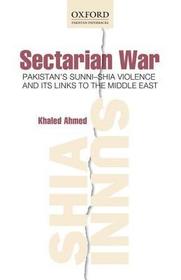
Sectarian War
Pakistan's Sunni-Shia Violence and its links to the Middle East
- Publisher's listprice GBP 11.99
-
5 413 Ft (5 155 Ft + 5% VAT)
The price is estimated because at the time of ordering we do not know what conversion rates will apply to HUF / product currency when the book arrives. In case HUF is weaker, the price increases slightly, in case HUF is stronger, the price goes lower slightly.
- Discount 10% (cc. 542 Ft off)
- Discounted price 4 871 Ft (4 640 Ft + 5% VAT)
Subcribe now and take benefit of a favourable price.
Subscribe
5 413 Ft

Availability
Out of print
Why don't you give exact delivery time?
Delivery time is estimated on our previous experiences. We give estimations only, because we order from outside Hungary, and the delivery time mainly depends on how quickly the publisher supplies the book. Faster or slower deliveries both happen, but we do our best to supply as quickly as possible.
Product details:
- Publisher OUP Pakistan
- Date of Publication 2 August 2012
- ISBN 9780199065936
- Binding Paperback
- No. of pages300 pages
- Size 214x140x18 mm
- Weight 406 g
- Language English 0
Categories
Long description:
The book is an account of how the Shia-Sunni conflict was relocated from the Middle East to Pakistan after the rise of Revolutionary Iran in 1979, through the mediating agency of the rulers in Pakistan and the proliferation of the religious seminaries funded by Saudi Arabia. It examines the death of General Zia in the context of the sectarian conflict, goes into the process of production of apostatising fatwas in Pakistan followed by violent action by organizations formed from the
non-state actors used by the state for its covert wars.
It also delves into the state of the Shia communities in the Middle East and their historical connections with South Asia. It examines the rise of Shia culture in Lucknow and its formative influence on the rise of the Shia in Iraq, with a parallel scrutiny of the rise of Wahhabism and its infiltration of India in the eighteenth century. It records the origins and history of organisations doing sectarian terrorism in Pakistan and their linkages to Al Qaeda whose trajectory into a sectarian
identity is also traced to the rise of Al Zarqawi as a parallel leader in Iraq. The book facilitates an understanding of the phenomenon of terrorism in Pakistan today.
Table of Contents:
Introduction
1. The Shia in Pakistan
2. The Sunni-Shia Schism
3. Soldiers of Sectarianism
4. Narrative of a Fearful Asymmetry
5. Shias in the Middle East
6. Transformation of Al Qaeda
Bibliography
Index

