

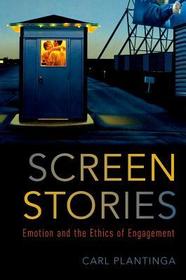
Screen Stories
Emotion and the Ethics of Engagement
- Publisher's listprice GBP 122.50
-
58 524 Ft (55 737 Ft + 5% VAT)
The price is estimated because at the time of ordering we do not know what conversion rates will apply to HUF / product currency when the book arrives. In case HUF is weaker, the price increases slightly, in case HUF is stronger, the price goes lower slightly.
- Discount 10% (cc. 5 852 Ft off)
- Discounted price 52 671 Ft (50 163 Ft + 5% VAT)
Subcribe now and take benefit of a favourable price.
Subscribe
58 524 Ft

Availability
printed on demand
Why don't you give exact delivery time?
Delivery time is estimated on our previous experiences. We give estimations only, because we order from outside Hungary, and the delivery time mainly depends on how quickly the publisher supplies the book. Faster or slower deliveries both happen, but we do our best to supply as quickly as possible.
Product details:
- Publisher OUP USA
- Date of Publication 31 May 2018
- ISBN 9780190867133
- Binding Hardback
- No. of pages326 pages
- Size 163x236x25 mm
- Weight 709 g
- Language English
- Illustrations 25 halftones; 2 line art 0
Categories
Short description:
As stories on screens claim a more pervasive and influential presence in contemporary culture, Screen Stories argues for a restructuring of film and media studies' approach to ethics.
MoreLong description:
The way we communicate with each other is vital to preserving the cultural ecology, or wellbeing, of a place and time. Do we listen to each other? Do we ask the right questions? Do we speak about each other with respect or disdain? The stories that we convey on screens, or what author Carl Plantinga calls 'screen stories,' are one powerful and pervasive means by which we communicate with each other. Screen Stories: Emotion and the Ethics of Engagement argues that film and media studies needs to move toward an an approach to ethics that is more appropriate for mass consumer culture and the lives of its citizens.
Primarily concerned with the relationship between media and viewers, this book considers ethical criticism and the emotional power of screen stories that makes such criticism necessary. The content we consume--from television shows and movies to advertisements--can significantly affect our welfare on a personal and societal level, and thus, this content is subject to praise and celebration, or questioning and even condemnation. The types of screen stories that circulate contribute to the cultural ecology of a time and place; through shared attention they influence what individuals think and feel. Plantinga develops a theory of the power of screen stories to affect both individuals and cultures, asserting that we can better respond ethically to such media if we understand the sources of its influence on us.
Table of Contents:
Introduction
The Evolution of a Perspective
Structure of the Book
Part One: The Power of Screen Stories
1. The Power of Screen Stories
2. The Rhetoric of Screen Stories
3. Transfer and Cultivation
4. Caveats and Complications
Part Two: Ethics and Engagement
5. Engagement and Estrangement
6. Immersion and Emotion
7. Moralities and Characters as Moral Agents
8. The Personal and the Political
9. Mood and Ethics
Part Three: The Contours of Engagement
10. Ethics and Character Engagement
11. Narrative Structure: Closure and Frame Shifters
12. Narrative Paradigm Scenarios: Revenge and the Other
13. Conclusion
Bibliography

