

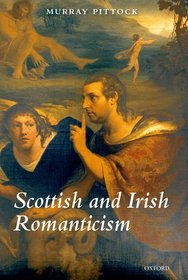
Scottish and Irish Romanticism
- Publisher's listprice GBP 107.50
-
51 358 Ft (48 912 Ft + 5% VAT)
The price is estimated because at the time of ordering we do not know what conversion rates will apply to HUF / product currency when the book arrives. In case HUF is weaker, the price increases slightly, in case HUF is stronger, the price goes lower slightly.
- Discount 10% (cc. 5 136 Ft off)
- Discounted price 46 222 Ft (44 021 Ft + 5% VAT)
Subcribe now and take benefit of a favourable price.
Subscribe
51 358 Ft

Availability
printed on demand
Why don't you give exact delivery time?
Delivery time is estimated on our previous experiences. We give estimations only, because we order from outside Hungary, and the delivery time mainly depends on how quickly the publisher supplies the book. Faster or slower deliveries both happen, but we do our best to supply as quickly as possible.
Product details:
- Publisher OUP Oxford
- Date of Publication 24 January 2008
- ISBN 9780199232796
- Binding Hardback
- No. of pages306 pages
- Size 240x164x21 mm
- Weight 603 g
- Language English 0
Categories
Short description:
In a challenge to existing accounts of Romanticism, Murray Pittock provides a broad re-reading of British Romanticism. Locating Scottish and Irish Romantic writing in the wider context of the British Isles, he explores the dialogue between national traditions through a detailed consideration of a range of Scottish, Irish, and English writers.
MoreLong description:
Scottish and Irish Romanticism is the first single-author book to address the main non-English Romanticisms of the British Isles. Murray Pittock begins by questioning the terms of his chosen title as he searches for a definition of Romanticism and for the meaning of 'national literature'. He proposes certain determining 'triggers' for the recognition of the presence of a national literature, and also deals with two major problems which are holding back the development of a new and broader understanding of British Isles Romanticisms: the survival of outdated assumptions in ostensibly more modern paradigms, and a lack of understanding of the full range of dialogues and relationships across the literatures of these islands. The theorists whose works chiefly inform the book are Bakhtin, Fanon and Habermas, although they do not define its arguments, and an alertness to the ways in which other literary theories inform each other is present throughout the book.
Pittock examines in turn the historiography, prejudices, and assumptions of Romantic criticism to date, and how our unexamined prejudices still stand in the way of our understanding of individual traditions and the dialogues between them. He then considers Allan Ramsay's role in song-collecting, hybridizing high cultural genres with broadside forms, creating in synthetic Scots a 'language really used by men', and promoting a domestic public sphere. Chapters 3 and 4 discuss the Scottish and Irish public spheres in the later eighteenth century, together with the struggle for control over national pasts, and the development of the cults of Romance, the Picturesque and Sentiment: Macpherson, Thomson, Owenson and Moore are among the writers discussed. Chapter 5 explores the work of Robert Fergusson and his contemporaries in both Scotland and Ireland, examining questions of literary hybridity across not only national but also linguistic borders, while Chapter 6 provides a brief literary history of Burns' descent into critical neglect combined with a revaluation of his poetry in the light of the general argument of the book. Chapter 7 analyzes the complexities of the linguistic and cultural politics of the national tale in Ireland through the work of Maria Edgeworth, while the following chapter considers of Scott in relation to the national tale, Enlightenment historiography, and the European nationalities question. Chapter 9 looks at the importance of the Gothic in Scottish and Irish Romanticism, particularly in the work of James Hogg and Charles Maturin, while Chapter 10, 'Fratriotism', explores a new concept in the manner in which Scottish and Irish literary, political and military figures of the period related to Empire.
It is difficult to do justice in a short review to a work of the depth and complexity of Scottish and Irish Romanticism ... this magisterial, intricate book is an important and nuanced challenge to the postwar version of literary Romanticism.
Table of Contents:
Preface
The Lake Isle of Romanticism: The Challenge to Literary History
Allan Ramsay and the Decolonization of Genre
Romance, the Aeolian Harp and the Theft of History
Strumming and Being Hanged: the Irish Bard and History Regained
Robert Fergusson and his Scottish and Irish Contemporaries
Robert Burns
Maria Edgeworth's National Tale
Scott and the European Nationalities Question
Hogg, Maturin, and the Gothic National Tale
Fratriotism: Sisters, Brothers, Empire and its Limits in the Scottish and Irish Imagination, c.1746-1837
Bibliography

