

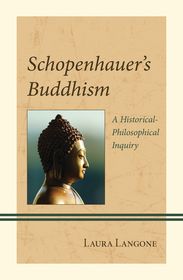
Schopenhauer's Buddhism
A Historical-Philosophical Inquiry
Series: Contemporary Studies in Idealism;
-
GET 18% OFF
- Publisher's listprice GBP 85.00
-
38 377 Ft (36 550 Ft + 5% VAT)
The price is estimated because at the time of ordering we do not know what conversion rates will apply to HUF / product currency when the book arrives. In case HUF is weaker, the price increases slightly, in case HUF is stronger, the price goes lower slightly.
- Discount 18% (cc. 1 Ft off)
- Discounted price 31 470 Ft (29 971 Ft + 5% VAT)
- Discount is valid until: 31 August 2026
31 470 Ft

Availability
printed on demand
Why don't you give exact delivery time?
Delivery time is estimated on our previous experiences. We give estimations only, because we order from outside Hungary, and the delivery time mainly depends on how quickly the publisher supplies the book. Faster or slower deliveries both happen, but we do our best to supply as quickly as possible.
Product details:
- Publisher Bloomsbury Publishing (UK)
- Date of Publication 17 July 2024
- Number of Volumes Hardback
- ISBN 9781666969504
- Binding Hardback
- No. of pages226 pages
- Size 232x160x20 mm
- Weight 480 g
- Language English 504
Categories
Long description:
In a letter from May 10, 1852, to Adam von Do---, Arthur Schopenhauer declared himself to be a Buddhist. From 1825 until his death, he never stopped searching for more information on Buddhism, with his thirst for knowledge of it growing over time. Schopenhauer's Buddhism: A Historical-Philosophical Inquiry is the first study to do justice to Schopenhauer's passion for Buddhism, reconstructing the notions of Buddhism he acquired through his readings on Buddhism as well as their influence on his thought. Laura Langone examines what Buddhism meant for Schopenhauer, what kind of Buddhism Schopenhauer had in mind, and how Buddhism shaped his philosophy. This book examines how the assimilation of Buddhist tenets through his Buddhist sources led him to incorporate the Buddhist concept of palingenesis into his philosophical system, which introduced a radically new metaphysical framework. Ultimately, Schopenhauer's incorporation of Buddhist palingenesis illustrates how Buddhism deeply spurred him to develop new and innovative ideas previously unthinkable in Western philosophy.
MoreTable of Contents:
Introduction
Chapter 1: Schopenhauer's Philosophy and Readings on Buddhism until 1818: The Early Years
Chapter 2: From 1818 until 1844: Religion, Genius, and Nirvana
Chapter 3: From 1850 Onwards: Asceticism, Negation, and the Ultimate Reality
Chapter 4: The Legacy of Schopenhauer's Buddhism: Wagner and Nietzsche
Conclusion
Appendix: Further Reading
Bibliography
About Author

