

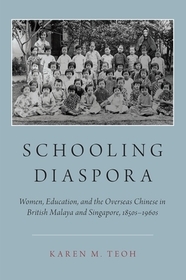
Schooling Diaspora
Women, Education, and the Overseas Chinese in British Malaya and Singapore, 1850s-1960s
- Publisher's listprice GBP 29.99
-
13 540 Ft (12 895 Ft + 5% VAT)
The price is estimated because at the time of ordering we do not know what conversion rates will apply to HUF / product currency when the book arrives. In case HUF is weaker, the price increases slightly, in case HUF is stronger, the price goes lower slightly.
- Discount 10% (cc. 1 354 Ft off)
- Discounted price 12 186 Ft (11 606 Ft + 5% VAT)
Subcribe now and take benefit of a favourable price.
Subscribe
13 540 Ft

Availability
Estimated delivery time: In stock at the publisher, but not at Prospero's office. Delivery time approx. 3-5 weeks.
Not in stock at Prospero.
Why don't you give exact delivery time?
Delivery time is estimated on our previous experiences. We give estimations only, because we order from outside Hungary, and the delivery time mainly depends on how quickly the publisher supplies the book. Faster or slower deliveries both happen, but we do our best to supply as quickly as possible.
Product details:
- Publisher OUP USA
- Date of Publication 17 July 2020
- ISBN 9780197533345
- Binding Paperback
- No. of pages248 pages
- Size 155x231x15 mm
- Weight 386 g
- Language English
- Illustrations 23 hts 4
Categories
Short description:
Schooling Diaspora looks into the motivations and strategies of missionaries, colonial authorities, and Chinese reformists and revolutionaries for educating girls, as well as the impact that this education had on identity formation among overseas Chinese women and larger society.
MoreLong description:
Education has long been a cornerstone of Chinese culture. Traditional Chinese norms have also held that the less education and exposure to influence from outside the home a girl had, the more likely she would be to remain true to conventional domestic values and to remain morally upright. In the mid-nineteenth century, overseas Chinese communities encountered a new perspective via Western European and American missionary schools. Formal education could be not just helpful but integral to preserving female virtue and had the added benefit of elevating the socio-cultural status of the overseas Chinese. As a result, increasing numbers of girls began to attend school. Within a few decades, other groups who sponsored female education-local Chinese community leaders, mainland Chinese reformists, the British colonial government-were offering a competing approach: education for the sake of modernization. These diverse and sometimes divergent priorities preoccupied educators, parents, politicians, and, of course, the girls and women who attended these institutions.
In this work, Karen Teoh relates the history of English and Chinese girls' schools that overseas Chinese founded and attended from the 1850s to the 1960s in British Malaya and Singapore. She examines the strategies of missionaries, colonial authorities, and Chinese reformists and revolutionaries for educating girls, as well as the impact that this education had on identity formation among overseas Chinese women and larger society. Such schools ranged from charitable missions operated by nuns who rescued orphans and prostitutes, to elite institutions for the daughters of the wealthy and powerful. They could tailor their curricula to suit the specific needs of female students, emphasizing domestic skills such as sewing and cooking, or, later, training for "women's work" in teaching, nursing, or secretarial jobs. They would help to produce what society needed, in the form of better wives and mothers, or workers and citizens of developing nation-states, while ensuring compliance with desired ideals. Chinese women in diaspora found that failing to conform to any number of state priorities could lead to social disapproval, marginalization, or even outright deportation. Overseas Chinese communities were mindful of these perils, and their responses were as myriad as their modes of identity construction and adaptation. They grappled with questions of how this project might support Chinese nationalism, absorb the best of British colonial influence, and strengthen their image as a stable, modern, and desirable population in their countries of settlement.
Bridging Chinese and Southeast Asian history, British imperialism, gender, and the history of education, Schooling Diaspora shows how these diasporic women contributed to the development of a new figure: the educated transnational Chinese woman.
Karen M. Teoh helps readers both visualise and envision, through descriptive and detailed research, the lives, culture, and lived experiences of overseas Chinese women in female schools in British Malaya and Singapore from 1850s to 1960s. The work is a collection of oral histories, shared experiences, and research that presents a remarkable tribute to the collective body of overseas Chinese females whose experiences are represented therein ... [it] ensures that the complicated and winding history of overseas educated Chinese in British Malaya and Singapore is neither overlooked nor forgotten. The work also ensures imagined notions of overseas Chinese and female education in historical British Malaya and Singapore are viewed through their authentic, deeply dynamic realities.
Table of Contents:
Acknowledgments
A Note on Spelling
Introduction: Women, Education, and Overseas Chinese Identity
Chapter 1: A Little Education, A Little Emancipation: The Colonial Politics of Female Education, 1850s-1950s
Chapter 2: Barrier against Evil, Encouragement for Good: English Girls' Schools, 1850s-1960s
Chapter 3: So That They May be an Honor to You: The Nyonya Problem and the Singapore Chinese Girls' School, 1890s-1940s
Chapter 4: Rare Flowers, Modern Girls, Good Citizens: Chinese Girls' Schools, 1900s-1950s
Chapter 5: Home is That Which I Adore: Re-migration to China, 1940s-1960s
Conclusion: The Domestic Citizen and Female Education in the Postcolonial Era
Notes
Bibliography
Index

