

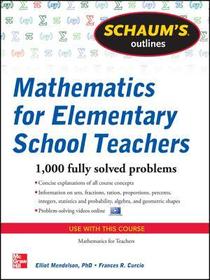
Schaum's Outline of Mathematics for Elementary School Teachers
Series: Schaum's Outline Series;
- Publisher's listprice GBP 12.99
-
5 864 Ft (5 585 Ft + 5% VAT)
The price is estimated because at the time of ordering we do not know what conversion rates will apply to HUF / product currency when the book arrives. In case HUF is weaker, the price increases slightly, in case HUF is stronger, the price goes lower slightly.
- Discount 10% (cc. 586 Ft off)
- Discounted price 5 278 Ft (5 027 Ft + 5% VAT)
Subcribe now and take benefit of a favourable price.
Subscribe
5 864 Ft

Availability
cancelled
Why don't you give exact delivery time?
Delivery time is estimated on our previous experiences. We give estimations only, because we order from outside Hungary, and the delivery time mainly depends on how quickly the publisher supplies the book. Faster or slower deliveries both happen, but we do our best to supply as quickly as possible.
Product details:
- Publisher McGraw-Hill Education
- Date of Publication 16 February 2017
- ISBN 9780071600477
- Binding Paperback
- No. of pages408 pages
- Language English 0
Categories
Long description:
Tough Test Questions? Missed Lectures? Not Enough Time?
Fortunately for you, there's Schaum's.
More than 40 million students have trusted Schaum's to help them succeed in the classroom and on exams. Schaum's is the key to faster learning and higher grades in every subject. Each Outline presents all the essential course information in an easy-to-follow, topic-by-topic format. You also get hundreds of examples, solvedproblems, and practice exercises to test your skills.
This Schaum's Outline gives you
- 1,000 fully solved problems
- Complete review of all course fundamentals
Fully compatible with your classroom text, Schaum's highlights all the important facts you need to know. Use Schaum's to shorten your study time--and get your best test scores!
Topics include: Number Systems; The Earliest Mathematics;Additive Systems; The Egyptian Number System;Alphabetic Systems;Positional Systems on a Fixed Base;Historical Examples of Positional Systems with a Base Different from Ten; The Babylonian Number System; The Mayan Number System;Method for Translating Base Ten into Base Two;The Algebra of Sets;Set Theoretic Exponentiation;Cardinal Numbers;Theory of Numbers;Mathematical Induction;Complete Induction;Prime Numbers;The Division Theorem;Testing for Primality;The Greatest Common Divisor;Irrational Numbers;Factorization into Primes;The Least Common Multiple;The Euclidean Algorithm;Some Famous Unsolved Problems (Perfect numbers, Fermat primes, The Goldbach Conjecture);Linear Diophantine Equations;Fractions (How is a fraction represented in diagrams?How are fractions represented on a number line?What is the “unit”?What is the “shifting unit”?What is the multiplicative identity element for fractions?What is a proper fraction?What is an improper fraction?When is a fraction larger than one whole?What is a unit fraction?How are fractions “simplified” (or “reduced”)?When is a fraction in “simplest form” (or “lowest terms”)?How are mixed numbers changed to improper fractions?What are equivalent fractions?How can we determine when fractions are equivalent?How are fractions ordered from largest to smallest or from smallest to largest? How are fractions compared to find the largest or smallest value?How is the least common denominator (LCD) determined? How is the numerator determined once the LCD or common denominator is known?How are fractions added and subtracted?What are the properties of fraction addition? How are fractions multiplied?What are the properties of fraction multiplication? Why is the product of two proper fractions smaller in value than either fraction factor? What is the “multiplicative inverse,” or “reciprocal” of a fraction?How are fractions divided?Why does the “invert-and-multiply” rule “work” when dividing fractions?What are complex fractions? How are complex fractions simplified?);
Decimals, Ratios, Proportions, and Percents (What is a decimal fraction?What is a mixed decimal?What are the place values for decimals?How are decimals written in expanded form?What are terminating decimals? What are equivalent decimals?What are repeating (or recurring) nonterminating decimals?What are nonepeating, nonterminating decimals?How can common fractions be written as decimals?How can decimals be written as common fractions? How are mixed numbers written as decimals?How are decimals ordered and compared?How are decimals rounded? How are decimals added and subtracted?How are decimals multiplied?Why is the placement of the decimal point in the product of two decimals determined by counting the number of decimal places in the factors?How is decimal multiplication the same as whole number multiplication? How is decimal multiplication different from whole number multiplication?How are decimals divided?How is decimal division different from whole number division? How is decimal division the same as whole number division?What does it mean to “add a zero” to the end of a decimal fraction?What is scientific notation and how is it used?What is a ratio?What is a rate? How are ratios and rates the same? How are they different?How are ratios expressed as decimals? As percents?When are two ratios equal?What is a proportion?What is a scaled drawing?How are scales used to calculate actual quantities?What does percent mean?How are percents changed to decimals?How are decimals changed to percents?How are percents changed to common fractions?How are common fractions changed to percents?What does a percent greater than 100% mean?What does a percent less than 1% mean?How is a percent of a number calculated and what does it mean?What are the aliquot parts of 100?How is the percent of a number calculated?When finding the percent of a number, when is it appropriate to use the fraction form of a rational number and when is it appropriate to use a decimal form of a rational number?How can we find a number when a percent of it is known? How is the percent of increase or decrease found?);
Algebra, Patterns, and Functions (What is a variable?How are a “variable” and an “unknown” the same? How are they different?What does the equal sign mean?What is an algebraic expression?What is an equation?What is a linear equation?How are linear equations solved?What is an inequality?How are linear inequalities solved?What is the absolute value of a number?What is a pattern? How are patterns used to solve problems?What is a function?What is the slope of a line?What is the y-intercept of a line? How is a linear equation graphed?What is factoring?How are algebraic expressions factored? What is the Pythagorean Theorem?What are Pythagorean triples?What is a quadratic equation?What is covariation?What is direct variation?What is inverse variation?);
Geometry and Measurement; Combinatorics and Probability; The Multiplication Principle; Terminology of Sets;Probability; The Meaning of Probability;Basic Ideas of Probability Theory: Probability Spaces Events;Conditional Probability;Independent Events;Random Variables and Expected Values;; Statistics; Distributions and Types of Data(What is a distribution?What is a normal distribution?What is a skewed distribution?What are discrete data (also known as “categorical data”) and how are they analyzed?What are continuous data (sometimes also called, numerical data) and how are they analyzed?);
Populations and Samples (What is the difference between a population and a sample?What is convenience sampling?What is systematic sampling?What is voluntary-response sampling?What is random sampling?What is a biased sample?What is a simulation?What are frequency tables and how are they constructed?What is relative frequency?What is a picture graph (also known as a pictograph, pictogram, or pictorial graph) and how is it constructed?What is a bar graph (also known as a bar chart) and how is it constructed?What is a double or multiple bar graph and how is it constructed?What is a stacked bar graph and how is it constructed?What is a histogram and how is it constructed?How are bar graphs and histograms the same? How are they different?What is a line graph (also known as a broken line graph) and how is it constructed?What is a double line graph and how is it constructed?What is a circle graph (also known as a pie graph, pie chart, pie diagram, area graph) and how is it constructed?What is a line plot?What is a stemplot (also known as a stem-and-leaf plot) and how is it constructed?What is a back-to-back stem-and-leaf plot and how is it constructed?What is a scatterplot and how is it constructed?What is correlation?What is a line of best fit and how can it be found?);
Measures of Center (What are measures of central tendency?What is the mean of a set of data (also known as the arithmetic mean or arithmetic average) and how is it determined? What is the median of a set of data and how is it found?What is the mode of a set of data?);
Measures of Spread (What are measures of dispersion?What is the range of a set of data and how is it calculated?What is the variance of a set of data and how is it calculated?What is the standard deviation of a set of data and how is it calculated?What are percentiles?What are quartiles and how are they determined?What is the interquartile range?What is a boxplot (also known as a box-and-whisker plot) and how is it constructed?What is an outlier and how is it determined?What is a cluster? What is a gap?What is a z-score (also standard score) and how is it calculated?)
Schaum's Outlines--Problem Solved.
Tough Test Questions? Missed Lectures? Not Enough Time?
Fortunately for you, there's Schaum's.
More than 40 million students have trusted Schaum's to help them succeed in the classroom and on exams. Schaum's is the key to faster learning and higher grades in every subject. Each Outline presents all the essential course information in an easy-to-follow, topic-by-topic format. You also get hundreds of examples, solvedproblems, and practice exercises to test your skills.
This Schaum's Outline gives you
- 1,000 fully solved problems
- Complete review of all course fundamentals
Fully compatible with your classroom text, Schaum's highlights all the important facts you need to know. Use Schaum's to shorten your study time--and get your best test scores!
Topics include: Number Systems; The Earliest Mathematics;Additive Systems; The Egyptian Number System;Alphabetic Systems;Positional Systems on a Fixed Base;Historical Examples of Positional Systems with a Base Different from Ten; The Babylonian Number System; The Mayan Number System;Method for Translating Base Ten into Base Two;The Algebra of Sets;Set Theoretic Exponentiation;Cardinal Numbers;Theory of Numbers;Mathematical Induction;Complete Induction;Prime Numbers;The Division Theorem;Testing for Primality;The Greatest Common Divisor;Irrational Numbers;Factorization into Primes;The Least Common Multiple;The Euclidean Algorithm;Some Famous Unsolved Problems (Perfect numbers, Fermat primes, The Goldbach Conjecture);Linear Diophantine Equations;Fractions (How is a fraction represented in diagrams?How are fractions represented on a number line?What is the “unit”?What is the “shifting unit”?What is the multiplicative identity element for fractions?What is a proper fraction?What is an improper fraction?When is a fraction larger than one whole?What is a unit fraction?How are fractions “simplified” (or “reduced”)?When is a fraction in “simplest form” (or “lowest terms”)?How are mixed numbers changed to improper fractions?What are equivalent fractions?How can we determine when fractions are equivalent?How are fractions ordered from largest to smallest or from smallest to largest? How are fractions compared to find the largest or smallest value?How is the least common denominator (LCD) determined? How is the numerator determined once the LCD or common denominator is known?How are fractions added and subtracted?What are the properties of fraction addition? How are fractions multiplied?What are the properties of fraction multiplication? Why is the product of two proper fractions smaller in value than either fraction factor? What is the “multiplicative inverse,” or “reciprocal” of a fraction?How are fractions divided?Why does the “invert-and-multiply” rule “work” when dividing fractions?What are complex fractions? How are complex fractions simplified?);
Decimals, Ratios, Proportions, and Percents (What is a decimal fraction?What is a mixed decimal?What are the place values for decimals?How are decimals written in expanded form?What are terminating decimals? What are equivalent decimals?What are repeating (or recurring) nonterminating decimals?What are nonepeating, nonterminating decimals?How can common fractions be written as decimals?How can decimals be written as common fractions? How are mixed numbers written as decimals?How are decimals ordered and compared?How are decimals rounded? How are decimals added and subtracted?How are decimals multiplied?Why is the placement of the decimal point in the product of two decimals determined by counting the number of decimal places in the factors?How is decimal multiplication the same as whole number multiplication? How is decimal multiplication different from whole number multiplication?How are decimals divided?How is decimal division different from whole number division? How is decimal division the same as whole number division?What does it mean to “add a zero” to the end of a decimal fraction?What is scientific notation and how is it used?What is a ratio?What is a rate? How are ratios and rates the same? How are they different?How are ratios expressed as decimals? As percents?When are two ratios equal?What is a proportion?What is a scaled drawing?How are scales used to calculate actual quantities?What does percent mean?How are percents changed to decimals?How are decimals changed to percents?How are percents changed to common fractions?How are common fractions changed to percents?What does a percent greater than 100% mean?What does a percent less than 1% mean?How is a percent of a number calculated and what does it mean?What are the aliquot parts of 100?How is the percent of a number calculated?When finding the percent of a number, when is it appropriate to use the fraction form of a rational number and when is it appropriate to use a decimal form of a rational number?How can we find a number when a percent of it is known? How is the percent of increase or decrease found?);
Algebra, Patterns, and Functions (What is a variable?How are a “variable” and an “unknown” the same? How are they different?What does the equal sign mean?What is an algebraic expression?What is an equation?What is a linear equation?How are linear equations solved?What is an inequality?How are linear inequalities solved?What is the absolute value of a number?What is a pattern? How are patterns used to solve problems?What is a function?What is the slope of a line?What is the y-intercept of a line? How is a linear equation graphed?What is factoring?How are algebraic expressions factored? What is the Pythagorean Theorem?What are Pythagorean triples?What is a quadratic equation?What is covariation?What is direct variation?What is inverse variation?);
Geometry and Measurement; Combinatorics and Probability; The Multiplication Principle; Terminology of Sets;Probability; The Meaning of Probability;Basic Ideas of Probability Theory: Probability Spaces Events;Conditional Probability;Independent Events;Random Variables and Expected Values;; Statistics; Distributions and Types of Data(What is a distribution?What is a normal distribution?What is a skewed distribution?What are discrete data (also known as “categorical data”) and how are they analyzed?What are continuous data (sometimes also called, numerical data) and how are they analyzed?);
Populations and Samples (What is the difference between a population and a sample?What is convenience sampling?What is systematic sampling?What is voluntary-response sampling?What is random sampling?What is a biased sample?What is a simulation?What are frequency tables and how are they constructed?What is relative frequency?What is a picture graph (also known as a pictograph, pictogram, or pictorial graph) and how is it constructed?What is a bar graph (also known as a bar chart) and how is it constructed?What is a double or multiple bar graph and how is it constructed?What is a stacked bar graph and how is it constructed?What is a histogram and how is it constructed?How are bar graphs and histograms the same? How are they different?What is a line graph (also known as a broken line graph) and how is it constructed?What is a double line graph and how is it constructed?What is a circle graph (also known as a pie graph, pie chart, pie diagram, area graph) and how is it constructed?What is a line plot?What is a stemplot (also known as a stem-and-leaf plot) and how is it constructed?What is a back-to-back stem-and-leaf plot and how is it constructed?What is a scatterplot and how is it constructed?What is correlation?What is a line of best fit and how can it be found?);
Measures of Center (What are measures of central tendency?What is the mean of a set of data (also known as the arithmetic mean or arithmetic average) and how is it determined? What is the median of a set of data and how is it found?What is the mode of a set of data?);
Measures of Spread (What are measures of dispersion?What is the range of a set of data and how is it calculated?What is the variance of a set of data and how is it calculated?What is the standard deviation of a set of data and how is it calculated?What are percentiles?What are quartiles and how are they determined?What is the interquartile range?What is a boxplot (also known as a box-and-whisker plot) and how is it constructed?What is an outlier and how is it determined?What is a cluster? What is a gap?What is a z-score (also standard score) and how is it calculated?)
Schaum's Outlines--Problem Solved.
MoreTable of Contents:
Chapter 1: Number Systems
The Earliest Mathematics
Additive Systems
The Egyptian Number System
Alphabetic Systems
Positional Systems on a Fixed Base
Historical Examples of Positional Systems with a Base Different from Ten
The Babylonian Number System
The Mayan Number System
Method for Translating Base Ten into Base Two
Chapter 2: Sets
The Algebra of Sets
Set Theoretic Exponentiation
Cardinal Numbers
Chapter 3: Theory of Numbers
Mathematical Induction
Complete Induction
Prime Numbers
The Division Theorem
Testing for Primality
The Greatest Common Divisor
Irrational Numbers
Factorization into Primes
The Least Common Multiple
The Euclidean Algorithm
Some Famous Unsolved Problems (Perfect numbers, Fermat primes, The Goldbach Conjecture)
Linear Diophantine Equations
Chapter 4: Fractions
Introduction
Try These First
4.1 What is a “fraction”?
4.2 How is a fraction represented in diagrams?
4.3 How are fractions represented on a number line?
4.4 What is the “unit”?
4.5 What is the “shifting unit”?
4.6 What is the multiplicative identity element for fractions?
4.7 What is a proper fraction?
4.8 What is an improper fraction?
4.9 When is a fraction larger than one whole?
4.10 What is a unit fraction?
4.11 How are fractions “simplified” (or “reduced”)?
4.12 When is a fraction in “simplest form” (or “lowest terms”)?
4.13 How are mixed numbers changed to improper fractions?
4.14 What are equivalent fractions?
4.15 How can we determine when fractions are equivalent?
4.16 How are fractions ordered from largest to smallest or from smallest to largest? How are fractions compared to find the largest or smallest value?
4.17 How is the least common denominator (LCD) determined?
4.18 How is the numerator determined once the LCD or common denominator is known?
4.19 How are fractions added and subtracted?
4.20 What are the properties of fraction addition?
4.21 How are fractions multiplied?
4.22 What are the properties of fraction multiplication?
4.23 Why is the product of two proper fractions smaller in value than either fraction factor?
4.24 What is the “multiplicative inverse,” or “reciprocal” of a fraction?
4.25 How are fractions divided?
4.26 Why does the “invert-and-multiply” rule “work” when dividing fractions?
4.27 What are complex fractions?
4.28 How are complex fractions simplified?
End of Chapter Exercises
Sample Certification Test Items
Chapter 5: Decimals, Ratios, Proportions, and Percents
Introduction
Try These First
5.1 What is a decimal fraction?
5.2 What is a mixed decimal?
5.3 What are the place values for decimals?
5.4 How are decimals written in expanded form?
5.5 What are terminating decimals?
5.6 What are equivalent decimals?
5.7 What are repeating (or recurring) nonterminating decimals?
5.8 What are nonepeating, nonterminating decimals?
5.9 How can common fractions be written as decimals?
5.10 How can decimals be written as common fractions?
5.11 How are mixed numbers written as decimals?
5.12 How are decimals ordered and compared?
5.13 How are decimals rounded?
5.14 How are decimals added and subtracted?
5.15 How are decimals multiplied?
5.16 Why is the placement of the decimal point in the product of two decimals determined by counting the number of decimal places in the factors?
5.17 How is decimal multiplication the same as whole number multiplication? How is decimal multiplication different from whole number multiplication?
5.18 How are decimals divided?
5.19 How is decimal division different from whole number
division? How is decimal division the same as whole number division?
5.20 What does it mean to “add a zero” to the end of a decimal fraction?
5.21 What is scientific notation and how is it used?
5.22 What is a ratio?
5.23 What is a rate?
5.24 How are ratios and rates the same? How are they different?
5.25 How are ratios expressed as decimals? As percents?
5.26 When are two ratios equal?
5.27 What is a proportion?
5.28 What is a scaled drawing?
5.29 How are scales used to calculate actual quantities?
5.30 What does percent mean?
5.31 How are percents changed to decimals?
5.32 How are decimals changed to percents?
5.33 How are percents changed to common fractions?
5.34 How are common fractions changed to percents?
5.35 What does a percent greater than 100% mean?
5.36 What does a percent less than 1% mean?
5.37 How is a percent of a number calculated and what does it mean?
5.38 What are the aliquot parts of 100?
5.39 How is the percent of a number calculated?
5.40 When finding the percent of a number, when is it appropriate to use the fraction form of a rational number and when is it appropriate to use a decimal form of a rational number?
5.41 How can we find a number when a percent of it is known?
5.42 How is the percent of increase or decrease found?
End of Chapter Exercises
Sample Certification Test Items
Chapter 6: Algebra, Patterns, and Functions
Introduction
Try These First
6.1 What is algebra?
6.2 What is a variable?
6.3 How are a “variable” and an “unknown” the same? How are they different?
6.4 What does the equal sign mean?
6.5 What is an algebraic expression?
6.6 What is an equation?
6.7 What is a linear equation?
6.8 How are linear equations solved?
6.9 What is an inequality?
6.10 How are linear inequalities solved?
6.11 What is the absolute value of a number?
6.12 What is a pattern? How are patterns used to solve problems?
6.13 What is a function?
6.14 What is the slope of a line?
6.15 What is the y-intercept of a line?
6.16 How is a linear equation graphed?
6.17 What is factoring?
6.18 How are algebraic expressions factored?
6.19 What is the Pythagorean Theorem?
6.20 What are Pythagorean triples?
6.21 What is a quadratic equation?
6.22 What is covariation?
6.23 What is direct variation?
6.24 What is inverse variation?
End of Chapter Exercises
Sample Certification Test Items
Chapter 7: Geometry and Measurement
Chapter 8: Combinatorics and Probability
Let Us Count the Ways
The Multiplication Principle
Terminology of Sets
Probability
The Meaning of Probability
Basic Ideas of Probability Theory: Probability Spaces Events
Conditional Probability
Independent Events
Random Variables and Expected Values
Chapter 9: Statistics
Introduction
Try These First
Distributions and Types of Data
9.1 What is a distribution?
9.2 What is a normal distribution?
9.3 What is a skewed distribution?
9.4 What are discrete data (also known as “categorical data”) and how are they analyzed?
9.5 What are continuous data (sometimes also called, numerical data) and how are they analyzed?
Populations and Samples
9.6 What is the difference between a population and a sample?
9.7 What is convenience sampling?
9.8 What is systematic sampling?
9.9 What is voluntary-response sampling?
9.10 What is random sampling?
9.11 What is a biased sample?
9.12 What is a simulation?
9.13 What are frequency tables and how are they constructed?
9.14 What is relative frequency?
9.15 What is a picture graph (also known as a pictograph, pictogram, or pictorial graph) and how is it constructed?
9.16 What is a bar graph (also known as a bar chart) and how is it constructed?
9.17 What is a double or multiple bar graph and how is it constructed?
9.18 What is a stacked bar graph and how is it constructed?
9.19 What is a histogram and how is it constructed?
9.20 How are bar graphs and histograms the same? How are they different?
9.21 What is a line graph (also known as a broken line graph) and how is it constructed?
9.22 What is a double line graph and how is it constructed?
9.23 What is a circle graph (also known as a pie graph, pie chart, pie diagram, area graph) and how is it constructed?
9.24 What is a line plot?
9.25 What is a stemplot (also known as a stem-and-leaf plot) and how is it constructed?
9.26 What is a back-to-back stem-and-leaf plot and how is it constructed?
9.27 What is a scatterplot and how is it constructed?
9.28 What is correlation?
9.29 What is a line of best fit and how can it be found?
Measures of Center
9.30 What are measures of central tendency?
9.31 What is the mean of a set of data (also known as the arithmetic mean or arithmetic average) and how is it determined?
9.32 What is the median of a set of data and how is it found?
9.33 What is the mode of a set of data?
Measures of Spread
9.34 What are measures of dispersion?
9.35 What is the range of a set of data and how is it calculated?
9.36 What is the variance of a set of data and how is it calculated?
9.37 What is the standard deviation of a set of data and how is it calculated?
9.38 What are percentiles?
9.39 What are quartiles and how are they determined?
9.40 What is the interquartile range?
9.41 What is a boxplot (also known as a box-and-whisker plot) and how is it constructed?
9.42 What is an outlier and how is it determined?
9.43 What is a cluster?
9.44 What is a gap?
9.45 What is a z-score (also standard score) and how is it calculated?
End of Chapter Exercises
Sample Certification Test Items
Bibliography
Answer KeyIndex

