

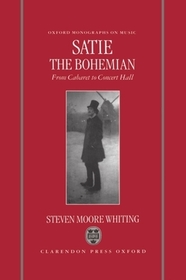
- Publisher's listprice GBP 255.00
-
121 826 Ft (116 025 Ft + 5% VAT)
The price is estimated because at the time of ordering we do not know what conversion rates will apply to HUF / product currency when the book arrives. In case HUF is weaker, the price increases slightly, in case HUF is stronger, the price goes lower slightly.
- Discount 10% (cc. 12 183 Ft off)
- Discounted price 109 644 Ft (104 423 Ft + 5% VAT)
Subcribe now and take benefit of a favourable price.
Subscribe
121 826 Ft

Availability
printed on demand
Why don't you give exact delivery time?
Delivery time is estimated on our previous experiences. We give estimations only, because we order from outside Hungary, and the delivery time mainly depends on how quickly the publisher supplies the book. Faster or slower deliveries both happen, but we do our best to supply as quickly as possible.
Product details:
- Publisher Clarendon Press
- Date of Publication 18 February 1999
- ISBN 9780198164586
- Binding Hardback
- No. of pages604 pages
- Size 244x162x37 mm
- Weight 1113 g
- Language English
- Illustrations 4 plates, 39 music examples 0
Categories
Short description:
The composer Erik Satie (1866-1925) came of age in the bohemian sub-culture of Montmartre, with its artists' cabarets and cafés-concerts. These colourful milieux decisively shaped his aesthetic priorities and compositional strategies, from the esoteric Gymnopédies of the 1880s to the avant-garde ballets of the 1920s. This radical transvaluation of received artistic values makes far better sense once placed in this fascinating context.
MoreLong description:
Erik Satie (1866-1925) came of age in the bohemian subculture of Montmartre, with its artists' cabarets and cafés-concerts. Yet apologists have all too often downplayed this background as potentially harmful to the reputation of a composer whom they regarded as the progenitor of modern French music. Whiting argues, on the contrary, that Satie's two decades in and around Montmartre decisively shaped his aesthetic priorities and compositional strategies. He gives the fullest account to date of Satie's professional activities as a popular musician, and of how he transferred the parodic techniques and musical idioms of cabaret entertainment to works for concert hall. From the esoteric Gymnopédies to the bizarre suites of the 1910s and avant-garde ballets of the 1920s (not to mention music journalism and playwriting), Satie's output may be daunting in its sheer diversity and heterodoxy; but his radical transvaluation of received artistic values makes far better sense once placed in the fascinating context of bohemian Montmartre.
Steven Moore Whiting now goes further than anybody in accounting for Satie in terms of his popular music context. He has also provided more detail about it than I ever thought possible - as a result of some twenty years' study and brilliant detective work. ... an indispensable repository of detailed information which enriches our enjoyment of this unique composer on every page. It is expensive but it's well produced and its dedicated research readably delivered brings Satie and his environment alive in a way which is not likely to be superceded.
Table of Contents:
Introduction
Part I: Café-Concert, Music-Hall, Cabaret
The Café-Concert
From Caf'ConÃ
' to Music-Hall
The Cabaret Artistique
Part II: Satie's Involvement in Popular Milieux
Satie at the Chat Noir
Satie and the Divan Japonais
Satie at the Auberge du Clou
From the Auberge du Clou to Arcueil
Satie and Hyspa
Of Pantomimes and Pears
Waltz, Cakewalk, Theatre Song
Part III: From Cabaret to Concert Hall
Satie's Humouristic Works for Piano
From Chanson to Mélodie and Back
The Composer as Playwright
Autour de Cocteau, or The Uses of Popular Music
On revient toujours: Satie's Last Ballets
List of Sources Cited
Index

