

- Publisher's listprice GBP 107.50
-
48 536 Ft (46 225 Ft + 5% VAT)
The price is estimated because at the time of ordering we do not know what conversion rates will apply to HUF / product currency when the book arrives. In case HUF is weaker, the price increases slightly, in case HUF is stronger, the price goes lower slightly.
- Discount 10% (cc. 4 853 Ft off)
- Discounted price 43 683 Ft (41 603 Ft + 5% VAT)
Subcribe now and take benefit of a favourable price.
Subscribe
48 536 Ft

Availability
printed on demand
Why don't you give exact delivery time?
Delivery time is estimated on our previous experiences. We give estimations only, because we order from outside Hungary, and the delivery time mainly depends on how quickly the publisher supplies the book. Faster or slower deliveries both happen, but we do our best to supply as quickly as possible.
Product details:
- Publisher OUP Oxford
- Date of Publication 2 November 2017
- ISBN 9780198811732
- Binding Hardback
- No. of pages278 pages
- Size 224x149x23 mm
- Weight 482 g
- Language English 0
Categories
Short description:
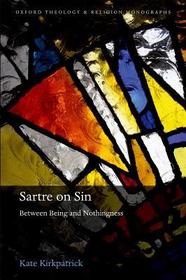
This work argues that Jean-Paul Sartre's early philosophy had a notable inheritance from the Christian doctrine of original sin. With particular attention to Being and Nothingness, Kirkpatrick connects Sartre to an Augustinian tradition of Christian thought according to which nothingness enters the world with the creation of the human.
MoreLong description:
Sartre on Sin: Between Being and Nothingness argues that Jean-Paul Sartre's early, anti-humanist philosophy is indebted to the Christian doctrine of original sin. On the standard reading, Sartre's most fundamental and attractive idea is freedom: he wished to demonstrate the existence of human freedom, and did so by connecting consciousness with nothingness. Focusing on Being and Nothingness, Kate Kirkpatrick demonstrates that Sartre's concept of nothingness (le néant) has a Christian genealogy which has been overlooked in philosophical and theological discussions of his work. Previous scholars have noted the resemblance between Sartre's and Augustine's ontologies: to name but one shared theme, both thinkers describe the human as the being through which nothingness enters the world. However, there has been no previous in-depth examination of this 'resemblance'. Using historical, exegetical, and conceptual methods, Kirkpatrick demonstrates that Sartre's intellectual formation prior to his discovery of phenomenology included theological elements-especially concerning the compatibility of freedom with sin and grace.
After outlining the French Augustinianisms by which Sartre's account of the human as 'between being and nothingness' was informed, Kirkpatrick offers a close reading of Being and Nothingness which shows that the psychological, epistemological, and ethical consequences of Sartre's le néant closely resemble the consequences of its theological predecessor; and that his account of freedom can be read as an anti-theodicy. Sartre on Sin illustrates that Sartre' s insights are valuable resources for contemporary hamartiology.
Any persons interested in exploring Sartre's French intellectual and/or theological inheritances would benefit from reviewing this book, as would any theologians who are looking to uncover theological traces in phenomenology and existentialism more broadly.
Table of Contents:
Chronology of Sartre's Works, 1924-1946
Abbreviations
A Note on Translations
Part I: Sartre and Sin
Sartre and Sin
Part II: A Genealogy of Nothingness
French Sins, I: 'Mystiques du néant' and 'les disciples de Saint Augustin'
French Sins, II: Individuals and their Sins
Part III: A Phenomenology of Sin
Problems of Nothingness: Identity, Anxiety, and Bad Faith
The Fallen Self: In Search of Lost Being
Lonely Togetherness: Shame, The Body, and Dissimilarity
Freedom: On Being our Own Nothingness
Part IV: Toward a Sartrean Hamartiology
Death of God, Death of Love: The Hermeneutics of Despair
Sin is Dead, Long Live Sin
References

