

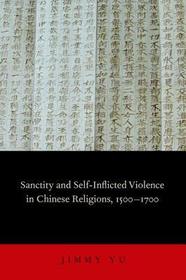
Sanctity and Self-Inflicted Violence in Chinese Religions, 1500-1700
- Publisher's listprice GBP 41.49
-
18 732 Ft (17 840 Ft + 5% VAT)
The price is estimated because at the time of ordering we do not know what conversion rates will apply to HUF / product currency when the book arrives. In case HUF is weaker, the price increases slightly, in case HUF is stronger, the price goes lower slightly.
- Discount 10% (cc. 1 873 Ft off)
- Discounted price 16 859 Ft (16 056 Ft + 5% VAT)
Subcribe now and take benefit of a favourable price.
Subscribe
18 732 Ft

Availability
printed on demand
Why don't you give exact delivery time?
Delivery time is estimated on our previous experiences. We give estimations only, because we order from outside Hungary, and the delivery time mainly depends on how quickly the publisher supplies the book. Faster or slower deliveries both happen, but we do our best to supply as quickly as possible.
Product details:
- Publisher OUP USA
- Date of Publication 24 May 2012
- ISBN 9780199844906
- Binding Paperback
- No. of pages288 pages
- Size 231x155x22 mm
- Weight 408 g
- Language English
- Illustrations 4 illustrations 0
Categories
Short description:
Jimmy Yu reveals that in the sixteenth and seventeenth centuries, self-inflicted violence was an essential and sanctioned part of Chinese culture. He examines a wide range of practices, including blood writing, filial body-slicing, chastity mutilations and suicides, ritual exposure, and self-immolation, arguing that each practice was public, scripted, and a signal of certain cultural expectations.
MoreLong description:
In this illuminating study of a vital but long overlooked aspect of Chinese religious life, Jimmy Yu reveals that in the sixteenth and seventeenth centuries, self-inflicted violence was an essential and sanctioned part of Chinese culture. He examines a wide range of practices, including blood writing, filial body-slicing, chastity mutilations and suicides, ritual exposure, and self-immolation, arguing that each practice was public, scripted, and a signal of certain cultural expectations.
Yu shows how individuals engaged in acts of self-inflicted violence to exercise power and to affect society, by articulating moral values, reinstituting order, forging new social relations, and protecting against the threat of moral ambiguity. Self-inflicted violence was intelligible both to the person doing the act and to those who viewed and interpreted it, regardless of the various religions of the period: Buddhism, Daoism, Confucianism, and other religions.
Self-inflicted violence as a category reveals scholarly biases that tend to marginalize or exaggerate certain phenomena in Chinese culture. Yu offers a groundbreaking contribution to scholarship on bodily practices in late imperial China, challenging preconceived ideas about analytic categories of religion, culture, and ritual in the study of Chinese religions.
this is an important and original study that should be widely read by students of Chinese culture and society.
Table of Contents:
List of illustrations
Acknowledgement
A Note on Dynasties and Reigns
Introduction
1. A Culture in Flux: Historical Background
2. Embodying the Text through Blood Writing
3. Nourishing the Parent with One's Own Flesh
4. Chaste Widows as Entertainment and Revenants
5. Exposing and Burning the Body for Rain
6. Conclusion
Character Glossary
Abbreviations and Conventions
Bibliography
Index

