

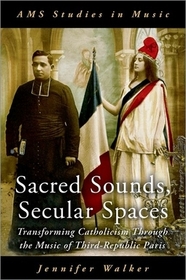
Sacred Sounds, Secular Spaces
Transforming Catholicism Through the Music of Third-Republic Paris
Series: AMS Studies in Music;
- Publisher's listprice GBP 78.00
-
35 217 Ft (33 540 Ft + 5% VAT)
The price is estimated because at the time of ordering we do not know what conversion rates will apply to HUF / product currency when the book arrives. In case HUF is weaker, the price increases slightly, in case HUF is stronger, the price goes lower slightly.
- Discount 10% (cc. 3 522 Ft off)
- Discounted price 31 695 Ft (30 186 Ft + 5% VAT)
Subcribe now and take benefit of a favourable price.
Subscribe
35 217 Ft

Availability
Estimated delivery time: In stock at the publisher, but not at Prospero's office. Delivery time approx. 3-5 weeks.
Not in stock at Prospero.
Why don't you give exact delivery time?
Delivery time is estimated on our previous experiences. We give estimations only, because we order from outside Hungary, and the delivery time mainly depends on how quickly the publisher supplies the book. Faster or slower deliveries both happen, but we do our best to supply as quickly as possible.
Product details:
- Publisher OUP USA
- Date of Publication 23 November 2021
- ISBN 9780197578056
- Binding Hardback
- No. of pages368 pages
- Size 243x165x27 mm
- Weight 667 g
- Language English
- Illustrations 40 examples, 3 tables, 7 figures 140
Categories
Short description:
Sacred Sounds, Secular Spaces provides the first fundamental reconsideration of music's role in the relationship between the French state and the Catholic Church in the Third Republic, revealing how composers and critics from often opposing ideological factions undermined the secular/sacred binary through composition and musical performance.
MoreLong description:
Military defeat, political and civil turmoil, and a growing unrest between Catholic traditionalists and increasingly secular Republicans formed the basis of a deep-seated identity crisis in Third Republic France. Beginning in the early 1880s, Republican politicians introduced increasingly secularizing legislation to the parliamentary floor that included, but was not limited to, the secularization of the French educational system. As the divide between Church and State widened on the political stage, more and more composers began writing religious--even liturgical--music for performance in decidedly secular venues, including popular cabaret theaters, prestigious opera houses, and international exhibitions. This trend coincided with Pope Leo XIII's Ralliement politics that encouraged conservative Catholics to "rally" with the Republican government. But the idea of a musical Ralliement has largely gone unquestioned by historians and musicologists alike.
Sacred Sounds, Secular Spaces provides the first fundamental reconsideration of music's role in the relationship between the French state and the Catholic Church in the Third Republic. In doing so, the book dismantles the somewhat simplistic epistemological position that emphasizes a sharp division between the Church and the "secular" Republic during this period. Drawing on extensive archival research, critical reception studies, and musical analysis, author Jennifer Walker reveals how composers and critics from often opposing ideological factions undermined the secular/sacred binary through composition and musical performance in an effort to craft a brand of Frenchness that was built on the dual foundations of secular Republicanism and the heritage of the French Catholic Church.
Sacred Sounds is particularly valuable because it demonstrates the surprising role of religious music in generating a French Republican culture.
Table of Contents:
Introduction
Chapter 1: The Catholic Church in Republican Musical Aesthetics
Chapter 2: Pious Puppets and the Limits of Symbolism
Chapter 3: Sincerity and the Limits of Symbolism
Chapter 4: Saint-Eustache: The Republic's Sacred Cathedral
Chapter 5: The Trocadéro: The Republic's Secular Cathedral
Chapter 6: The Republic's Righteous Woman at the Opéra-Comique: Jules Massenet's Grisélidis
Conclusion
Appendix A: "Les grands oratorios à l'église Saint-Eustache": Programs
Appendix B: Jules Massenet's La Terre promise: Biblical References
Appendix C: Programs of the Ten concerts officiels at the 1900 Exposition Universelle
Bibliography
Index

