

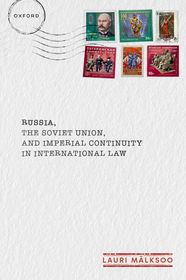
Russia, the Soviet Union, and Imperial Continuity in International Law
- Publisher's listprice GBP 100.00
-
45 150 Ft (43 000 Ft + 5% VAT)
The price is estimated because at the time of ordering we do not know what conversion rates will apply to HUF / product currency when the book arrives. In case HUF is weaker, the price increases slightly, in case HUF is stronger, the price goes lower slightly.
- Discount 10% (cc. 4 515 Ft off)
- Discounted price 40 635 Ft (38 700 Ft + 5% VAT)
Subcribe now and take benefit of a favourable price.
Subscribe
45 150 Ft

Availability
printed on demand
Why don't you give exact delivery time?
Delivery time is estimated on our previous experiences. We give estimations only, because we order from outside Hungary, and the delivery time mainly depends on how quickly the publisher supplies the book. Faster or slower deliveries both happen, but we do our best to supply as quickly as possible.
Product details:
- Publisher OUP Oxford
- Date of Publication 4 November 2025
- ISBN 9780198955931
- Binding Hardback
- No. of pages252 pages
- Size 241x164x21 mm
- Weight 542 g
- Language English 735
Categories
Short description:
Russia, the Soviet Union, and Imperial Continuity in International Law explores the history of imperial ideas and practices in Russian and Soviet engagements with international law from the 16th century to our present time.
MoreLong description:
Russia, the Soviet Union, and Imperial Continuity in International Law explores the history of imperial ideas and practices in Russian and Soviet engagements with international law. This volume traces the role of international legal doctrines and arguments in facilitating the expansion of the Russian Empire, their transition into Soviet Russia post-1917, and their use after the disintegration of the Soviet Union in 1991.
Particular attention is paid to Russian and Soviet international legal doctrines concerning the termination of treaties (clausula rebus sic stantibus), identity and continuity of Russia in the context of state succession, hegemonic doctrines such as the great power status of Russia (or the Soviet Union), and various interpretations of balance of power and spheres of influence, including the doctrine of socialist international law. In building its narrative, the book draws extensively on previously under-studied international law periodicals published in Russia and the Soviet Union, including the Soviet Yearbook of International Law, Soviet State and Law and Moscow Journal of International Law.
Table of Contents:
Introductory Chapter
The Russian Empire until the Crimean War (1853-6)
The Late Russian Empire (1856-1917)
From Soviet Russia to the Soviet Union: The Interwar Period and the Second World War
Interwar Soviet International Law Scholars and the Buildup to the Nazi-Soviet Pact of 1939
The Cold War: Interpretations of Soviet State Identity, Federalism, and Self-Determination
The Cold War: Soviet Views on Treaties, Peaceful Coexistence, and Socialist International Law as Imperial Doctrines
From Perestroika to Putin's Russia: Swinging Back to the Imperial Concept of International Law
In Conclusion

