

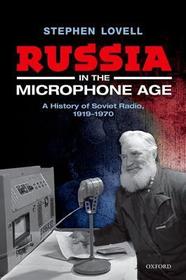
Russia in the Microphone Age
A History of Soviet Radio, 1919-1970
Series: Oxford Studies in Modern European History;
- Publisher's listprice GBP 61.00
-
27 541 Ft (26 230 Ft + 5% VAT)
The price is estimated because at the time of ordering we do not know what conversion rates will apply to HUF / product currency when the book arrives. In case HUF is weaker, the price increases slightly, in case HUF is stronger, the price goes lower slightly.
- Discount 10% (cc. 2 754 Ft off)
- Discounted price 24 787 Ft (23 607 Ft + 5% VAT)
Subcribe now and take benefit of a favourable price.
Subscribe
27 541 Ft

Availability
printed on demand
Why don't you give exact delivery time?
Delivery time is estimated on our previous experiences. We give estimations only, because we order from outside Hungary, and the delivery time mainly depends on how quickly the publisher supplies the book. Faster or slower deliveries both happen, but we do our best to supply as quickly as possible.
Product details:
- Publisher OUP Oxford
- Date of Publication 25 June 2015
- ISBN 9780198725268
- Binding Hardback
- No. of pages250 pages
- Size 241x163x19 mm
- Weight 532 g
- Language English 0
Categories
Short description:
The first history in English of Soviet radio from its earliest days to the advent of television, showing the role played by broadcasting in establishing control of the Soviet State up to the 1970s: including the Cultural Revolution, Stalinist 1930s, World War II, the Cold War, and de-Stalinization.
MoreLong description:
The story of radio begins alongside that of the Soviet state: Russia's first long-range transmission of the human voice occurred in 1919, during the civil war. Sound broadcasting was a medium of exceptional promise for this revolutionary regime. It could bring the Bolsheviks' message to the furthest corners of their enormous country. It had unprecedented impact: the voice of Moscow could now be wired into the very workplaces and living spaces of a population that was still only weakly literate.
The liveness and immediacy of broadcasting also created vivid new ways of communicating 'Sovietness' - whether through May Day parades and elections, the exploits of aviators and explorers, or show trials and public criticism. Yet, in the USSR as elsewhere, broadcasting was a medium in flux: technology, the broadcasting profession, and the listening audience were never static. Soviet radio was quickly earmarked as the mouthpiece of Soviet power, yet its history is also full of unintended consequences. The supreme irony of Soviet 'radiofication' was that its greatest triumph - the expansion of the wireless-listening public in the Cold War era - made possible its greatest failure, by turning a part of the Soviet audience into devotees of Western broadcasting.
Based on substantial original research in Moscow, St Petersburg, and Nizhnii Novgorod, Russia in the Microphone Age is the first full history of Soviet radio in English. In addition to the institutional and technological dimensions of the subject, it explores the development of programme content and broadcasting genres. It also goes in search of the mysterious figure of the Soviet listener. The result is a pioneering treatment of broadcasting as an integral part of Soviet culture from its early days in the 1920s until the dawn of the television age.
In this outstanding new history, Stephen Lovell traces the rise of Soviet radio and, with it, Soviet modes of listening....Lovell's book has much to recommend it. Its temporal scope allows him to trace the evolution of radio from the Stalinist to the Brezhnev era and to study its changing significance within Soviet culture....Russia in the Microphone Agewill now be the definitive volume on the subject, and one hopes it will lead to further case studies. It should be read by anyone interested in media history or the history of radio, but it also has much to tell about the history of the Soviet project and, with it, the history of the twentieth century.
Table of Contents:
Glossary
Abbreviations
Acknowledgements
Introduction: Why Radio?
Institutionalizing Soviet Radio
Radio and the Making of Soviet Society
How Russia Learned to Broadcast
Mobilizing Radio: The War
From Wire to Efir
The Magnitofon and the Art of Soviet Broadcasting
Radio Genres and Their Audiences in the Postwar Era
Epilogue
Note on Sources
Bibliography
Index

