

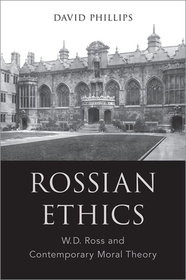
Rossian Ethics
W.D. Ross and Contemporary Moral Theory
- Publisher's listprice GBP 69.00
-
31 153 Ft (29 670 Ft + 5% VAT)
The price is estimated because at the time of ordering we do not know what conversion rates will apply to HUF / product currency when the book arrives. In case HUF is weaker, the price increases slightly, in case HUF is stronger, the price goes lower slightly.
- Discount 10% (cc. 3 115 Ft off)
- Discounted price 28 038 Ft (26 703 Ft + 5% VAT)
Subcribe now and take benefit of a favourable price.
Subscribe
31 153 Ft

Availability
printed on demand
Why don't you give exact delivery time?
Delivery time is estimated on our previous experiences. We give estimations only, because we order from outside Hungary, and the delivery time mainly depends on how quickly the publisher supplies the book. Faster or slower deliveries both happen, but we do our best to supply as quickly as possible.
Product details:
- Publisher OUP USA
- Date of Publication 12 August 2019
- ISBN 9780190602185
- Binding Hardback
- No. of pages232 pages
- Size 213x147x25 mm
- Weight 363 g
- Language English 0
Categories
Short description:
W.D. Ross (1877-1971) was the most important opponent of utilitarianism and consequentialism in British moral philosophy between 1861 and 1939. In Rossian Ethics, David Phillips offers the first monograph devoted exclusively to Ross's seminal contribution to moral philosophy. The book has two connected aims. The first is to interpret and evaluate Ross's moral theory. The second is to articulate a distinctive view intermediate between consequentialism and absolutist deontology, which Phillips calls "classical deontology."
MoreLong description:
W.D. Ross (1877-1971) was the most important opponent of utilitarianism and consequentialism in British moral philosophy between 1861 and 1939. In Rossian Ethics, David Phillips offers the first monograph devoted exclusively to Ross's seminal contribution to moral philosophy.
The book has two connected aims. The first is to interpret and evaluate Ross's moral theory, focusing on its three key elements: his introduction of the concept of prima facie duty, his limited pluralism about the right, and his limited pluralism about the good. The metaethical and epistemological framework within which Ross develops his moral theory is the subject of the fifth and final chapter of the book.
The second aim is to articulate a distinctive view intermediate between consequentialism and absolutist deontology, which Phillips calls "classical deontology." According to classical deontology the most fundamental normative principles are principles of prima facie duty, principles which specify general kinds of reasons. Consequentialists are right to think that reasons always derive from goods; ideal utilitarians are right, contra hedonistic utilitarians, to think that there are a small number of distinct kinds of intrinsic goods. But consequentialists are wrong to think that all reasons have the same weight for all agents. Instead there are a small number of distinct kinds of agent-relative intensifiers: features that increase the importance of certain goods for certain agents. Phillips claims that classical deontology combines the best elements of the moral theories of Ross and of Sidgwick, ultimately arguing that Ross is best interpreted as a classical deontologist.
This is an excellent, thoughtful, and accessible book.
Table of Contents:
Chapter One: Introduction
Chapter Two: What are Prima Facie Duties?
Chapter Three: What Prima Facie Duties are there? Ross, Agent-Relativity, and the Rejection of Consequentialism
Chapter Four: What Things are Good?
Chapter Five: The Metaethical and Epistemological Framework

