

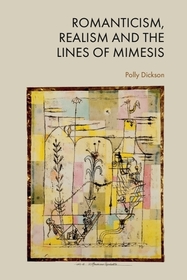
Romanticism, Realism and the Lines of Mimesis
- Publisher's listprice GBP 19.99
-
9 025 Ft (8 595 Ft + 5% VAT)
The price is estimated because at the time of ordering we do not know what conversion rates will apply to HUF / product currency when the book arrives. In case HUF is weaker, the price increases slightly, in case HUF is stronger, the price goes lower slightly.
- Discount 8% (cc. 722 Ft off)
- Discounted price 8 303 Ft (7 907 Ft + 5% VAT)
Subcribe now and take benefit of a favourable price.
Subscribe
9 025 Ft

Availability
Estimated delivery time: In stock at the publisher, but not at Prospero's office. Delivery time approx. 3-5 weeks.
Not in stock at Prospero.
Why don't you give exact delivery time?
Delivery time is estimated on our previous experiences. We give estimations only, because we order from outside Hungary, and the delivery time mainly depends on how quickly the publisher supplies the book. Faster or slower deliveries both happen, but we do our best to supply as quickly as possible.
Product details:
- Publisher Edinburgh University Press
- Date of Publication 1 January 2026
- ISBN 9781399506519
- Binding Paperback
- No. of pages240 pages
- Size 234x156 mm
- Language English
- Illustrations 8 black and white illustrations 650
Categories
Short description:
Examines the role occupied by the senses and the self in approaches to literary mimesis in nineteenth-century European literature
MoreLong description:
Since Plato’s Republic, mimesis — the artwork’s tacit claim to reflect or imitate real life — has faced a near-constant stream of assaults, being accused of naturalising a supposedly uncomplicated relationship between world and fiction. Lines of Mimesis offers a revisionary account of mimesis. Specifically, it proposes a rethinking of the representational attitudes of two literary schools usually understood to be at odds with one another — Romanticism and Realism — through close readings of writings and drawings made by two figures usually taken to be proponents of those schools respectively: E. T. A. Hoffmann and Honoré de Balzac. Across these readings, Dickson argues that a more capacious understanding of mimesis is achieved when we understand it to pertain not to the reduplication of objects in the world, but to a negotiation of the subject’s sensory entwinement with those objects. This new understanding can, in turn, more closely illuminate an artwork’s own reflections on its relationship to the world, shedding light on the entanglements and crossovers between Romanticism and Realism.
MoreTable of Contents:
List of Figures
Acknowledgements
Notes on Abbreviations and Translations
Introduction: Balzac and Hoffman
I: Mimesis
1. Mimesis and the Chiasm
2. A Brief History of Undulating Lines
II: Lines
3. Arabesque: Der goldne Topf and La Peau de chagrin
4. Scribble: Der Artushof and Le Chef-d’oeuvre inconnu
5. Cross: Die Elixiere des Teufels and L’Élixir de longue vie
Conclusion: Fiction's Pretexts
Bibliography
Index
More
