

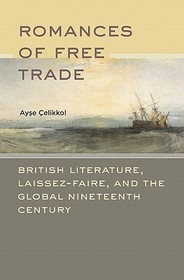
Romances of Free Trade
British Literature, Laissez-Faire, and the Global Nineteenth Century
- Publisher's listprice GBP 110.00
-
49 665 Ft (47 300 Ft + 5% VAT)
The price is estimated because at the time of ordering we do not know what conversion rates will apply to HUF / product currency when the book arrives. In case HUF is weaker, the price increases slightly, in case HUF is stronger, the price goes lower slightly.
- Discount 10% (cc. 4 967 Ft off)
- Discounted price 44 699 Ft (42 570 Ft + 5% VAT)
Subcribe now and take benefit of a favourable price.
Subscribe
49 665 Ft

Availability
printed on demand
Why don't you give exact delivery time?
Delivery time is estimated on our previous experiences. We give estimations only, because we order from outside Hungary, and the delivery time mainly depends on how quickly the publisher supplies the book. Faster or slower deliveries both happen, but we do our best to supply as quickly as possible.
Product details:
- Publisher OUP USA
- Date of Publication 11 August 2011
- ISBN 9780199769001
- Binding Hardback
- No. of pages208 pages
- Size 160x239x22 mm
- Weight 448 g
- Language English 0
Categories
Short description:
Drawing on works by Walter Scott, Dickens, Charlotte Brontë, and others, Romances of Free Trade offers a new account of the cultural work of romance in nineteenth-century Britain, arguing that novelists and playwrights employed the genre to represent a radically new historical formation: the emergence of the global free-market economy.
MoreLong description:
Romances of Free Trade offers a new account of the cultural work of romance in nineteenth-century Britain. Çelikkol argues that novelists and playwrights employed this genre to represent a radically new historical formation: the emergence of the global free-market economy. In previous centuries, the British state had pursued an economic policy that privileged domestic goods over foreign ones. Through the first half of the nineteenth century, liberal economists maintained that commodity traffic across national borders should move outside the purview of the state, and their position gained increasing support. Amid economic transformation, Britons pondered the effects of vertiginous circulation. Would patriotic attachment to the homeland dissolve along with the preference for domestic goods? What would be the fate of the nation and the empire if commerce were uncontrollable? The literary genre of romance, characterized by protagonists who drift in lawless spaces, played a privileged role in addressing such pressing questions. From the figure of the smuggler to episodic plot structure, romance elements in fiction and drama narrated sprawling global markets and the fluidity of capital. Exploring works by Walter Scott, Harriet Martineau, Charlotte Brontë, Charles Dickens and their lesser-known contemporaries, this book historicizes globalization as it traces the sense of dissolving borders and the perceived decline of national sovereignty back into the nineteenth century.
a fine contribution to a relatively new field, offering fresh insights on canonical, non-canonical, liberal and conservative, realist and non-realist literary texts and their relationship with political economy in the nineteenth century.
Table of Contents:
Acknowledgments
1. Introduction: Narrating Global Capitalism in the Romance Mode
2. Walter Scott's Disloyal Smugglers
3. Meandering Merchants and Narrators in Captain Marryat's Nautical Fiction
4. Harriet Martineau on the Fertility of Exchange
5. Promiscuity, Commerce, and Closure in Early Victorian Drama
6. Mutuality, Marriage, and Charlotte Brontë's Free Traders
7. The Compression of Space in Charles Dickens's Little Dorrit
8. Epilogue: Cycles of Capitalist Expansion
Endnotes
Select Bibliography
Index

