

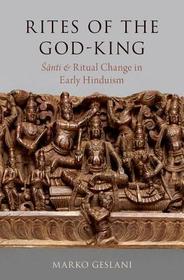
Rites of the God-King
Śānti and Ritual Change in Early Hinduism
Series: Oxford Ritual Studies Series;
- Publisher's listprice GBP 102.50
-
46 278 Ft (44 075 Ft + 5% VAT)
The price is estimated because at the time of ordering we do not know what conversion rates will apply to HUF / product currency when the book arrives. In case HUF is weaker, the price increases slightly, in case HUF is stronger, the price goes lower slightly.
- Discount 10% (cc. 4 628 Ft off)
- Discounted price 41 651 Ft (39 668 Ft + 5% VAT)
Subcribe now and take benefit of a favourable price.
Subscribe
46 278 Ft

Availability
printed on demand
Why don't you give exact delivery time?
Delivery time is estimated on our previous experiences. We give estimations only, because we order from outside Hungary, and the delivery time mainly depends on how quickly the publisher supplies the book. Faster or slower deliveries both happen, but we do our best to supply as quickly as possible.
Product details:
- Publisher OUP USA
- Date of Publication 19 July 2018
- ISBN 9780190862886
- Binding Hardback
- No. of pages336 pages
- Size 160x236x30 mm
- Weight 576 g
- Language English 0
Categories
Short description:
Rites of the God-King offers a critical revision of mainstream Hinduism from the perspective of the life of a single ritual from medieval India. Drawing theoretical connections to modern ethnographies, it raises questions about the nature of kingship and priesthood, image-worship, and ritual change.
MoreLong description:
Scholars of Vedic religion have long recognized the centrality of ritual categories to Indian thought. There have been few successful attempts, however, to bring the same systematic rigor of Vedic Scholarship to bear on later "Hindu" ritual. Excavating the deep history of a prominent ritual category in "classical" Hindu texts, Geslani traces the emergence of a class of rituals known as Śānti, or appeasement. This ritual, intended to counteract ominous omens, developed from the intersection of the fourth Vedathe oft-neglected Atharvavedaand the emergent tradition of astral science (Jyotiśāstra) sometime in the early first millennium, CE. Its development would come to have far-reaching consequences on the ideal ritual life of the king in early-medieval Brahmanical society. The mantric transformations involved in the history of śānti led to the emergence of a politicized ritual culture that could encompass both traditional Vedic and newer Hindu performers and practices.
From astrological appeasement to gift-giving, coronation, and image worship, Rites of the God-King chronicles the multiple lives and afterlives of a single ritual mode, unveiling the always-inventive work of the priesthood to imagine and enrich royal power. Along the way, Geslani reveals the surprising role of astrologers in Hindu history, elaborates conceptions of sin and misfortune, and forges new connections between medieval texts and modern practices. In a work that details ritual forms that were dispersed widely across Asia, he concludes with a reflection on the nature of orthopraxy, ritual change, and the problem of presence in the Hindu tradition.
Rites of the God-King is a wonderfully incisive examination of the ritual development of early Hinduism that compels us to expect further breakthroughs in the study of this subject.
Table of Contents:
Preface
Acknowledgements
Abbreviations
Introduction
1. The Inception of a Ritual Category
2. The Ritual Culture of Appeasement
3. Varahamihira's Astrological Ritualism
4. Kingship in a Portentous Age
5. Signs in the Gods, Gods in the Pots
6. Ritual Change and the Problem of Presence
Conclusion
Appendices
Glossary
Bibliography

