

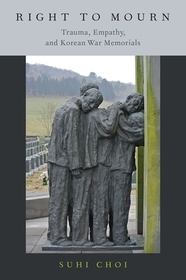
Right to Mourn
Trauma, Empathy, and Korean War Memorials
- Publisher's listprice GBP 83.00
-
39 653 Ft (37 765 Ft + 5% VAT)
The price is estimated because at the time of ordering we do not know what conversion rates will apply to HUF / product currency when the book arrives. In case HUF is weaker, the price increases slightly, in case HUF is stronger, the price goes lower slightly.
- Discount 10% (cc. 3 965 Ft off)
- Discounted price 35 688 Ft (33 989 Ft + 5% VAT)
Subcribe now and take benefit of a favourable price.
Subscribe
39 653 Ft

Availability
Estimated delivery time: In stock at the publisher, but not at Prospero's office. Delivery time approx. 3-5 weeks.
Not in stock at Prospero.
Why don't you give exact delivery time?
Delivery time is estimated on our previous experiences. We give estimations only, because we order from outside Hungary, and the delivery time mainly depends on how quickly the publisher supplies the book. Faster or slower deliveries both happen, but we do our best to supply as quickly as possible.
Product details:
- Publisher OUP USA
- Date of Publication 1 November 2019
- ISBN 9780190855246
- Binding Hardback
- No. of pages180 pages
- Size 142x213x20 mm
- Weight 340 g
- Language English
- Illustrations 29 8
Categories
Short description:
Through the lens of Korean War memorials, Right to Mourn looks at how long-suppressed memories become public, and asks how a physical monument can possibly communicate trauma and facilitate mourning.
MoreLong description:
In the highly politicized memory space of postwar South Korea, many families have been deprived of their right to mourn loved ones lost in the Korean War. Only since the 1990s has the government begun to acknowledge the atrocities committed by South Korean and American troops that resulted in large numbers of civilian casualties. The Truth and Reconciliation Committee, new laws honoring victims, and construction of monuments and memorials have finally opened public spaces for mourning. In Right to Mourn, Suhi Choi explores this new context of remembering in which memories that have long been private are brought into official sites. As the generation that once carried these memories fades away, Choi poses an increasingly critical question: can a memorial communicate trauma and facilitate mourning?
Through careful examination of recently built Korean War memorials (the Jeju April 3 Peace Park, the Memorial for the Gurye Victims of Yosun Killings, and the No Gun Ri Peace Park), Right to Mourn provokes readers to look at the nearly seven-decade-old war within the most updated context, and shows how suppressed trauma manifests at the transient interactions among bodies, objects, and rituals at the sites of these memorials.
Table of Contents:
Acknowledgments
Introduction
Chapter 1: Suppressed Mourners of the Korean War
Chapter 2: The Jeju April 3 Peace Park: An Uncanny Site of Empathy
Chapter 3: Gurye: A Muted Site of Remembering the Yosun Killings
Chapter 4: Reenacting Survivors' Bodies in the No Gun Ri Peace Park
Epilogue
Bibliography

