

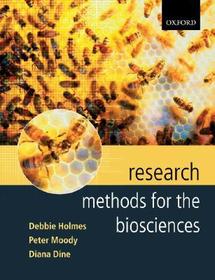
Research Methods for the Biosciences
- Publisher's listprice GBP 26.99
-
12 185 Ft (11 605 Ft + 5% VAT)
The price is estimated because at the time of ordering we do not know what conversion rates will apply to HUF / product currency when the book arrives. In case HUF is weaker, the price increases slightly, in case HUF is stronger, the price goes lower slightly.
- Discount 10% (cc. 1 218 Ft off)
- Discounted price 10 967 Ft (10 445 Ft + 5% VAT)
Subcribe now and take benefit of a favourable price.
Subscribe
12 185 Ft

Availability
Out of print
Why don't you give exact delivery time?
Delivery time is estimated on our previous experiences. We give estimations only, because we order from outside Hungary, and the delivery time mainly depends on how quickly the publisher supplies the book. Faster or slower deliveries both happen, but we do our best to supply as quickly as possible.
Product details:
- Publisher Oxford University Press
- Date of Publication 19 January 2006
- ISBN 9780199276929
- Binding Paperback
- No. of pages399 pages
- Size 246x189x23 mm
- Weight 770 g
- Language English
- Illustrations Tables and line drawings throughout 0
Categories
Short description:
Research Methods for the Biosciences demystifies the process of research to equip every biosciences student with the skills they need to perform their own investigations. The book leads students through all the factors that, together, enable effective research. These include planning your experiment; data collection, analysis, interpretation and reporting; and legal, ethical and health & safety issues.
Research Methods for the Biosciences brings together as a coherent whole the knowledge and skills required of every good researcher, making it the essential resource for any biosciences student.
Long description:
Scientific research is the ultimate tool in pushing forward the limit of our understanding. But, as with any tool, research is only powerful if used properly, and to its full effect.
Research Methods for the Biosciences demystifies the process of research to equip every biosciences student with the skills they need to get the most out of their investigations. Research isn't solely about experimental design; the book leads them through all the factors that, together, enable effective research. These include planning your experiment; data collection, analysis, interpretation, and reporting; and legal, ethical, and health & safety considerations.
Research is about engagement with the subject; with this in mind, Research Methods for the Biosciences includes a fully integrated web site, which motivates the student to fully consider the factors covered in the book, fostering understanding through active learning.
Research Methods for the Biosciences brings together as a coherent whole the knowledge and skills required of every good researcher, making it the essential resource for any biosciences student.
Online Resource Centre:
A fully interactive online component is an integral part of this resource. It features:
? Figures from the book available to download, to facilitate lecture preparation
? A totally flexible teaching and learning package, keyed directly to the text, featuring interactive tasks and exercises for both formative and summative assessment, and additional reference materials for both student and lecturer.
Well-organised and easy to read, Research Methods for the Biosciences is a useful tool for undergraduates, not to mention those involved in teaching in this field.
Table of Contents:
Introduction
Where do I begin?
Experimental design
What to do with raw data
An introduction to hypothesis testing
Hypothesis testing: Do my data fit an expected ratio?
Hypothesis testing: Associations and Relationships
Hypothesis testing: Do my samples come from the same population? Parametric data
Hypothesis testing: Do my samples come from the same population? Non-parametric data
Research, the law and you
Reporting your research
Appendices
A. How to choose a research project
B. Which statistcal test should I choose?
C. Maths and statistics
D. Tables of critical values for statistical tests
Glossary
References
Index

