

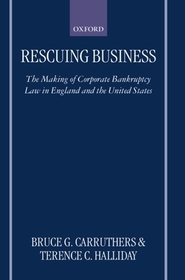
Rescuing Business
The Making of Corporate Bankruptcy Law in England and the United States
- Publisher's listprice GBP 97.00
-
43 795 Ft (41 710 Ft + 5% VAT)
The price is estimated because at the time of ordering we do not know what conversion rates will apply to HUF / product currency when the book arrives. In case HUF is weaker, the price increases slightly, in case HUF is stronger, the price goes lower slightly.
- Discount 10% (cc. 4 379 Ft off)
- Discounted price 39 416 Ft (37 539 Ft + 5% VAT)
Subcribe now and take benefit of a favourable price.
Subscribe
43 795 Ft

Availability
printed on demand
Why don't you give exact delivery time?
Delivery time is estimated on our previous experiences. We give estimations only, because we order from outside Hungary, and the delivery time mainly depends on how quickly the publisher supplies the book. Faster or slower deliveries both happen, but we do our best to supply as quickly as possible.
Product details:
- Publisher OUP Oxford
- Date of Publication 9 July 1998
- ISBN 9780198264729
- Binding Hardback
- No. of pages598 pages
- Size 224x146x37 mm
- Weight 912 g
- Language English 0
Categories
Short description:
Corporate bankruptcy is a defining characteristic of the market economy. It encapsulates the fundamental conflict between capital and labour. Yet, with one or two notable exceptions, the political and social dynamics of bankruptcy law and practice have been largely overlooked by socio-legal scholars. This book remedies that neglect. It compares English and American insolvency laws to identify the underlying political forces that established corporate bankruptcy law on both sides of the Atlantic. It shows how corporate insovency regulation is the creation of the lawyers who interpret and administer it. This book will be welcomed as an important sociological study and advances our understanding of how substantive law results from conflicts among the professionals who help to create it.
MoreLong description:
Corporate bankruptcy is a defining characteristic of the market economy. It encapsulates the fundamental conflicts between capital and labour, owners and managers, debtors and creditors, the state and the market. Yet, with one or two notable exceptions, the political and social dynamics of bankruptcy law and practice have been overlooked by serious socio-legal scholars.
This book remedies that neglect. Adopting an approach that compares English and American law, the authors identify the underlying political forces that established corporate bankruptcy law on both sides of the Atlantic. The book demonstrates how, by a recursive loop of professional self-interest, corporate insovency regulation is the creation of the lawyers who interpret and administer it.
This book will be welcomed as an important sociological study and advances our understanding of how substantive law results from conflicts among the professionals who help to create it.
via the theoretical framework, a useful perspective is offered that might be productively employed in other business history contexts ... A second contribution lies in the richness of the analysis of legal change during the specified periods ... the analysis is comprehensive and the work is a definitive future reference point on Anglo-American bankruptcy law. Most important of all, the book offers a valuable template for the study of corporate and institutional change.
Table of Contents:
Part 1. The Balance of Power in the Corporate Credit Network
Meta-bargaining over Property Rights
Professional Innovation and the Recursivity of Law
The Structure of Influence in Bankruptcy Law-making
Part 2. Reconstituting Property Rights
Introduction
Weakening the Strong: Banks and Secured Lenders (with J Scott Parrott)
Restraining the State and Utilities
Enabling Managers
Empowering the Weak: The Forgotten Class
Part 3. Reconstituing Jurisdictional Rights
Introduction
Privatization and Nationalization of Bankruptcy Administration
Jurisdictional Conflicts in the Market
Jurisdictional Struggles within the State
Part 4. Conclusion
Professions in the Institutionalization of Business Rescue

