

- Publisher's listprice GBP 78.00
-
35 217 Ft (33 540 Ft + 5% VAT)
The price is estimated because at the time of ordering we do not know what conversion rates will apply to HUF / product currency when the book arrives. In case HUF is weaker, the price increases slightly, in case HUF is stronger, the price goes lower slightly.
- Discount 10% (cc. 3 522 Ft off)
- Discounted price 31 695 Ft (30 186 Ft + 5% VAT)
Subcribe now and take benefit of a favourable price.
Subscribe
35 217 Ft

Availability
printed on demand
Why don't you give exact delivery time?
Delivery time is estimated on our previous experiences. We give estimations only, because we order from outside Hungary, and the delivery time mainly depends on how quickly the publisher supplies the book. Faster or slower deliveries both happen, but we do our best to supply as quickly as possible.
Product details:
- Publisher OUP Oxford
- Date of Publication 7 November 2002
- ISBN 9780199251643
- Binding Hardback
- No. of pages318 pages
- Size 224x145x22 mm
- Weight 568 g
- Language English
- Illustrations numerous tables and figures 0
Categories
Short description:
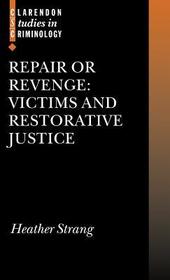
Over the past three decades, the victim movement worldwide has agitated for an enhanced role for victims in the criminal justice system. In this book Heather Strang argues that, despite some progress towards that goal, structural as well as political factors may mean that victims have won as much as they are likely to gain from conventional justice processing. She asks whether restorative justice can offer them more justice than they receive from the formal court-based system. Drawing on a five-year study of the impact of a restorative justice programme on victims of both property and violent crime, Strang presents empirical evidence to show that the restorative alternative of conferencing more often than court-based solutions has the capacity to satisfy victims' expectations of achieving a meaningful role in the way their cases are dealt with as well as delivering restoration, especially emotional restoration, from the harm they have suffered.
MoreLong description:
This book addresses the role of victims in our criminal justice system and the shortcomings they perceive in the way they are treated. It examines whether restorative justice can offer them more justice than they receive from the formal court-based system.
Research into the shortcomings of the court-based system has identified a number of issues that victims want to address. In brief, they want a less formal process where their views count, more information about both the processing and the outcome of their case, a greater opportunity for participation in the way their case is dealt with, fairer and more respectful treatment, and emotional as well as material restoration as an outcome. Over the past three decades, the victim movement worldwide has agitated for an enhanced role for victims in criminal justice. Despite some successes, it appears that structural as well as political factors may mean that victims have won as much as they are likely to gain from formal justice.
A series of randomized controlled trials in Canberra, known as the Reintegrative Shaming Experiments (RISE), has provided an opportunity to compare rigorously the impact on victims of court-based justice with a restorative justice program known as conferencing. In these experiments, middle-range property and violent offences committed by young offenders were assigned either to court (as they would normally have been treated) or to a conference.
Empirical evidence from RISE examined in this book suggests that the restorative alternative of conferencing more often than court has the capacity to give victims what they say they want in achieving meaningful victim participation and restoration, especially emotional restoration.
It is useful to have research focusing on the victim's perspective.
Table of Contents:
The Victim in Criminal Justice
Victims of Crime and the Victim Movement
The Theory and Practice of Restorative Justice
The Reintegrative Shaming Experiments: Research Design and Methodology
The Lived Experience of Victims: How Restorative Justice Worked in Canberra
Victim Satisfaction with the Restorative Alternative
Victims and Offenders: A Relational Analysis
Conclusion

