

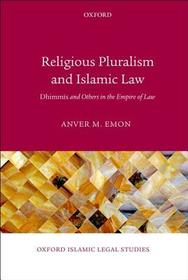
Religious Pluralism and Islamic Law
Dhimmis and Others in the Empire of Law
Series: Oxford Islamic Legal Studies;
- Publisher's listprice GBP 155.00
-
69 982 Ft (66 650 Ft + 5% VAT)
The price is estimated because at the time of ordering we do not know what conversion rates will apply to HUF / product currency when the book arrives. In case HUF is weaker, the price increases slightly, in case HUF is stronger, the price goes lower slightly.
- Discount 10% (cc. 6 998 Ft off)
- Discounted price 62 984 Ft (59 985 Ft + 5% VAT)
Subcribe now and take benefit of a favourable price.
Subscribe
69 982 Ft

Availability
printed on demand
Why don't you give exact delivery time?
Delivery time is estimated on our previous experiences. We give estimations only, because we order from outside Hungary, and the delivery time mainly depends on how quickly the publisher supplies the book. Faster or slower deliveries both happen, but we do our best to supply as quickly as possible.
Product details:
- Publisher OUP Oxford
- Date of Publication 26 July 2012
- ISBN 9780199661633
- Binding Hardback
- No. of pages382 pages
- Size 241x163x29 mm
- Weight 734 g
- Language English 0
Categories
Short description:
Analysing the rules governing the treatment of foreigners in Islam and situating them in their historical, political, and legal context, this book sets out a new framework for understanding these rules as part of a wider problem of governing through law amidst pluralism.
MoreLong description:
The question of tolerance and Islam is not a new one. Polemicists are certain that Islam is not a tolerant religion. As evidence they point to the rules governing the treatment of non-Muslim permanent residents in Muslim lands, namely the dhimmi rules that are at the center of this study. These rules, when read in isolation, are certainly discriminatory in nature. They legitimate discriminatory treatment on grounds of what could be said to be religious faith and religious difference. The dhimmi rules are often invoked as proof-positive of the inherent intolerance of the Islamic faith (and thereby of any believing Muslim) toward the non-Muslim.
This book addresses the problem of the concept of 'tolerance' for understanding the significance of the dhimmi rules that governed and regulated non-Muslim permanent residents in Islamic lands. In doing so, it suggests that the Islamic legal treatment of non-Muslims is symptomatic of the more general challenge of governing a diverse polity. Far from being constitutive of an Islamic ethos, the dhimmi rules raise important thematic questions about Rule of Law, governance, and how the pursuit of pluralism through the institutions of law and governance is a messy business.
As argued throughout this book, an inescapable, and all-too-often painful, bottom line in the pursuit of pluralism is that it requires impositions and limitations on freedoms that are considered central and fundamental to an individual's well-being, but which must be limited for some people in some circumstances for reasons extending well beyond the claims of a given individual. A comparison to recent cases from the United States, United Kingdom, and the European Court of Human Rights reveals that however different and distant premodern Islamic and modern democratic societies may be in terms of time, space, and values, legal systems face similar challenges when governing a populace in which minority and majority groups diverge on the meaning and implication of values deemed fundamental to a particular polity.
Polytheists and the irreligious were anathematized in classical Islam, but it assigned People of the Book, mainly Christians and Jews, to an intermediate protected category, the dhimma. Much writing on this institution takes sides, arguing that it was a mechanism either for interreligious harmony or for persecution of minorities. Anver Emon, in his weighty and original Religious Pluralism and Islamic Law, rejects both opposing views, as well as the concept of tolerance as a useful analytical tool.
Table of Contents:
Introduction
Dhimmis, Shari'a, and Empire
Reason, Contract, and the Obligation to Obey
Pluralism, Dhimmi Rules, and the Regulation of Difference
The Rationale of Empire and the Hegemony of Law
Shari'a as Rule of Law
The Dhimmi Rules in the Post-Colonial Muslim State
Religious Minorities and the Empire of the Law
Conclusion

