

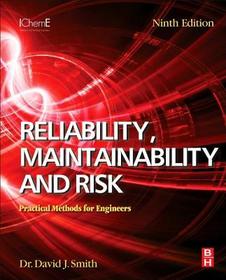
Reliability, Maintainability and Risk
Practical Methods for Engineers
- Publisher's listprice EUR 71.95
-
29 841 Ft (28 420 Ft + 5% VAT)
The price is estimated because at the time of ordering we do not know what conversion rates will apply to HUF / product currency when the book arrives. In case HUF is weaker, the price increases slightly, in case HUF is stronger, the price goes lower slightly.
- Discount 10% (cc. 2 984 Ft off)
- Discounted price 26 857 Ft (25 578 Ft + 5% VAT)
Subcribe now and take benefit of a favourable price.
Subscribe
29 841 Ft

Availability
Out of print
Why don't you give exact delivery time?
Delivery time is estimated on our previous experiences. We give estimations only, because we order from outside Hungary, and the delivery time mainly depends on how quickly the publisher supplies the book. Faster or slower deliveries both happen, but we do our best to supply as quickly as possible.
Product details:
- Edition number 9
- Publisher Elsevier Science
- Date of Publication 21 March 2017
- ISBN 9780081020104
- Binding Paperback
- No. of pages478 pages
- Size 234x190 mm
- Weight 990 g
- Language English 0
Categories
Long description:
Reliability, Maintainability and Risk: Practical Methods for Engineers, Ninth Edition, has taught reliability and safety engineers techniques to minimize process design, operation defects, and failures for 35 years.
For beginners, the book provides tactics on how to avoid pitfalls in this complex and wide field. For experts in the field, well-described, realistic, and illustrative examples and case studies add new insight and assistance. The author uses his 40 years of experience to create a comprehensive and detailed guide to the field, also providing an excellent description of reliability and risk computation concepts.
The book is organized into five parts. Part One covers reliability parameters and costs traces the history of reliability and safety technology, presenting a cost-effective approach to quality, reliability, and safety. Part Two deals with the interpretation of failure rates, while Part Three focuses on the prediction of reliability and risk.
Part Four discusses design and assurance techniques, review and testing techniques, reliability growth modeling, field data collection and feedback, predicting and demonstrating repair times, quantified reliability maintenance, and systematic failures, while Part 5 deals with legal, management and safety issues, such as project management, product liability, and safety legislation.
MoreTable of Contents:
Part 1: Understanding Reliability Parameters and Costs
1. The History of Reliability and Safety Technology
2. Understanding Terms and Jargon
3. A Cost-Effective Approach to Quality, Reliability and Safety
Part 2: Interpreting Failure Rates
4. Realistic Failure Rates and Prediction Confidence
5. Interpreting Data and Demonstrating Reliability
6. Variable Failure Rates and Probability Plotting
Part 3: Predicting Reliability and Risk
7. Basic Reliability Prediction Theory
8.ï¿1⁄2Methods of Modeling
9. Quantifying the Reliability Models
10. Risk Assessment (QRA)
Part 4: Achieving Reliability and Maintainability
11. Design and Assurance Techniques
12. Design Review, Test and Reliability Growth
13. Field Data Collection and Feedback
14. Factors Influencing Down Time
15. Predicting and Demonstrating Repair Times
16. Quantified Reliability Centered Maintenance
17. Systematic Failures, Especially Software
Part 5: Legal, Management and Safety Considerations
18. Project Management and Competence
19. Contract Clauses and Their Pitfalls
20. Product Liability and Safety Legislation
21. Major Incident Legislation
22. Integrity of Safety-Related Systems
23. A Case Study: The Datamet Project
24. A Case Study: Gas Detection System
25. A Case Study: Pressure Control System
26. Helicopter Incidents and Risk Assessment
Appendix 1: Glossary
Appendix 2: Percentage Points of the Chi-Square Distribution
Appendix 3: Microelectronic Failure Rates
Appendix 4: General Failure Rates
Appendix 5: Failure Mode Percentages
Appendix 6: Human Error Probabilities
Appendix 7: Fatality Rates
Appendix 8: Answers to Exercises
Appendix 9: Bibliography
Appendix 10: Scoring Criteria for BETAPLUS Common Cause Model
Appendix 11: Example of HAZOP
Appendix 12: HAZID Checklist
Appendix 13: Markov Analysis of Redundant Systems
Appendix 14: Calculating the GDF

