

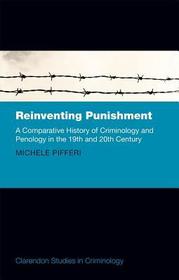
Reinventing Punishment
A Comparative History of Criminology and Penology in the Nineteenth and Twentieth Centuries
Series: Clarendon Studies in Criminology;
- Publisher's listprice GBP 76.00
-
36 309 Ft (34 580 Ft + 5% VAT)
The price is estimated because at the time of ordering we do not know what conversion rates will apply to HUF / product currency when the book arrives. In case HUF is weaker, the price increases slightly, in case HUF is stronger, the price goes lower slightly.
- Discount 10% (cc. 3 631 Ft off)
- Discounted price 32 678 Ft (31 122 Ft + 5% VAT)
Subcribe now and take benefit of a favourable price.
Subscribe
36 309 Ft

Availability
printed on demand
Why don't you give exact delivery time?
Delivery time is estimated on our previous experiences. We give estimations only, because we order from outside Hungary, and the delivery time mainly depends on how quickly the publisher supplies the book. Faster or slower deliveries both happen, but we do our best to supply as quickly as possible.
Product details:
- Publisher OUP Oxford
- Date of Publication 9 June 2016
- ISBN 9780198743217
- Binding Hardback
- No. of pages324 pages
- Size 223x148x24 mm
- Weight 548 g
- Language English 0
Categories
Short description:
A comparative approach to the history of criminology and penology between 1870s and 1930s, charting the history of the influence of criminological ideas on criminal law systems and sentencing methods and providing an interpretation of the divide between American and European penologies.
MoreLong description:
Providing a historical analysis of the impact of criminology on the rationale of punishment and the sentencing systems in Europe and the United States between the 1870s and the 1930s, Reinventing Punishment: A Comparative History of Criminology and Penology in the Nineteenth and Twentieth Centuries investigates and contrasts the rise of the principles of individualization of punishment, social defence, preventive justice, and indeterminate sentencing.
The manner in which US and European jurisprudence enforced these ideas resulted in the emergence of two different penological identities: the US penal reform movement led to the adoption of the indeterminate sentence system, whereas the European criminological approach resulted in the formulation of the dual-track system with punishment and measures of security. This theoretical divide, discussed at many international congresses and in studies of comparative criminal law, not only reflects two different ideas on the legitimacy and purpose of punishment, but also corresponds to two different constitutional views of criminal law. The book considers the relation between constitutional frameworks (rule of law and Rechtsstaat) and penological claims, explaining how some of the tenets of penal liberalism (such as principle of legality and separation of powers) were affected by penal modernism, even with the rise of authoritarian regimes. It examines the dilemmas provoked by criminology, focusing on the role of the judge in the execution of sentences, the distribution of sentencing powers among judicial and administrative bodies, the balance between social security and individual guarantees, and the inconsistencies of preventive detention.
Filling a notable gap in Anglo-American literature by providing a sophisticated panoramic analysis of the development of criminology in late-nineteenth and first half of the twentieth-century Europe, Reinventing Punishment will be of interest to scholars of criminology, criminal law, and criminal justice studies, as well as legal historians and theorists.
Reinventing Punishment is an impressive contribution to criminology, intellectual history and the sociology of law. I am excited about how it will spur the recently renewed scholarly interest in the history of criminology, the early history of policy-informing criminal science and the genealogy of criminal responsibilty.
Table of Contents:
Introduction
Designing the 'New Horizons' of Punishment
The Origins of Different Penological Identities
The Struggle over the Indeterminacy of Punishment in the USE (1870s-1900s)
The Concept of Indeterminate Sentence in the European Criminal Law Doctrine
The Formation of the European Dual-Track System
The 'New Penology' as a Constitutional Matter: The Crisis of Legality in the Rule of Law and the Rechtsstaat (1900s-1930s)
Nulla poena sine lege and the Sentencing Discretion
From Repression to Prevention: The Uncertain Borders between Jurisdiction and Administration
The Constitutional Conundrum of the Limits to Preventive Detention
Conclusions

