

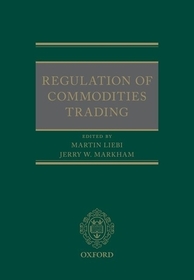
Regulation of Commodities Trading
- Publisher's listprice GBP 232.50
-
111 076 Ft (105 787 Ft + 5% VAT)
The price is estimated because at the time of ordering we do not know what conversion rates will apply to HUF / product currency when the book arrives. In case HUF is weaker, the price increases slightly, in case HUF is stronger, the price goes lower slightly.
- Discount 10% (cc. 11 108 Ft off)
- Discounted price 99 969 Ft (95 208 Ft + 5% VAT)
Subcribe now and take benefit of a favourable price.
Subscribe
111 076 Ft

Availability
Estimated delivery time: Expected time of arrival: end of January 2026.
Not in stock at Prospero.
Why don't you give exact delivery time?
Delivery time is estimated on our previous experiences. We give estimations only, because we order from outside Hungary, and the delivery time mainly depends on how quickly the publisher supplies the book. Faster or slower deliveries both happen, but we do our best to supply as quickly as possible.
Product details:
- Publisher OUP Oxford
- Date of Publication 26 March 2020
- ISBN 9780198799962
- Binding Hardback
- No. of pages432 pages
- Size 246x176x31 mm
- Weight 874 g
- Language English 48
Categories
Short description:
This book draws together the various regulations which affect how commodities are traded in the EU, and the relevant domestic regulation in key global jurisdictions. The book includes analysis of commodities trading houses (including their motives and methods), the main trading venues, trading practices, and illicit practices and market abuses.
MoreLong description:
This book is the first to draw together the numerous different regulations which affect how commodities are traded in the EU.
Having long been a largely deregulated industry, intense scrutiny in the aftermath of the global financial crisis has left commodities trading subject to a raft of harmonized regulations, many of which have yet to be finalized. Regulation of both the physical and the financial commodities markets is undergoing significant change and participants and their advisors are struggling to understand the changes in each jurisdiction as well as the cross-border implications.
The book pulls together these various pieces of EU legislation and examines how they influence the way that commodities are traded in Europe. It also provides coverage of regulation at domestic level in key jurisdictions active in the marketplace, namely the UK, USA, Switzerland, and Singapore. Divided into eight sections, the book includes analysis of the commodities trading houses (including their motives and methods), the main trading venues, trading practices, and potential illicit practices and market abuses. Each section has a detailed transnational component in which the position in each specific jurisdiction is explained, drawing parallels and setting out the differences between these countries.
This extremely topical publication is an essential reference work for all those advising on or researching the increasingly complex and globalized field of commodities trading.
Table of Contents:
Chapter 1 Introduction
Chapter 2 Commodity Trading Houses
Chapter 3 Trading Venues
Chapter 4 Trading
Chapter 5 Market Abuse
Chapter 6 Benchmark
Chapter 7 Illicit Behaviour

