

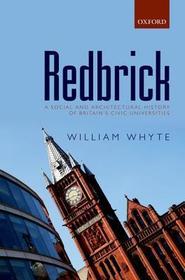
Redbrick
A social and architectural history of Britain's civic universities
- Publisher's listprice GBP 147.50
-
70 468 Ft (67 112 Ft + 5% VAT)
The price is estimated because at the time of ordering we do not know what conversion rates will apply to HUF / product currency when the book arrives. In case HUF is weaker, the price increases slightly, in case HUF is stronger, the price goes lower slightly.
- Discount 10% (cc. 7 047 Ft off)
- Discounted price 63 421 Ft (60 401 Ft + 5% VAT)
Subcribe now and take benefit of a favourable price.
Subscribe
70 468 Ft

Availability
printed on demand
Why don't you give exact delivery time?
Delivery time is estimated on our previous experiences. We give estimations only, because we order from outside Hungary, and the delivery time mainly depends on how quickly the publisher supplies the book. Faster or slower deliveries both happen, but we do our best to supply as quickly as possible.
Product details:
- Publisher OUP Oxford
- Date of Publication 15 January 2015
- ISBN 9780198716129
- Binding Hardback
- No. of pages416 pages
- Size 240x162x26 mm
- Weight 860 g
- Language English
- Illustrations 50 black and white images 0
Categories
Short description:
The first full-scale study of Britain's civic universities for 50 years, arguing that the education model created by Redbrick institutions has become the normal university experience throughout the country, shaping the lives and careers of millions.
MoreLong description:
In the last two centuries Britain has experienced a revolution in higher education, with the number of students rising from a few hundred to several million. Yet the institutions that drove -- and still drive -- this change have been all but ignored by historians.
Drawing on a decade's research, and based on work in dozens of archives, many of them used for the very first time, this is the first full-scale study of the civic universities -- new institutions in the nineteenth century reflecting the growth of major Victorian cities in Britain, such as Liverpool, Manchester, and Birmingham -- for more than 50 years. Tracing their story from the 1780s until the 2010s, it is an ambitious attempt to write the Redbrick revolution back into history.
William Whyte argues that these institutions created a distinctive and influential conception of the university -- something that was embodied in their architecture and expressed in the lives of their students and staff. It was this Redbrick model that would shape their successors founded in the twentieth century: ensuring that the normal university experience in Britain is a Redbrick one.
Using a vast range of previously untapped sources, Redbrick is not just a new history, but a new sort of university history: one that seeks to rescue the social and architectural aspects of education from the disregard of previous scholars, and thus provide the richest possible account of university life.
It will be of interest to students and scholars of modern British history, to anyone who has ever attended university, and to all those who want to understand how our higher education system has developed -- and how it may evolve in the future.
Whyte has written a fascinating architectural and social history of the development of British universities
Table of Contents:
List of Abbreviations
List of Illustrations
Introduction
Part One: 1783-1843
New universities for a new century
The people and places of the University of London
Part Two: 1843-1880
Experiments in Ireland and England
Building the mid-Victorian university
Part Three: 1880-1914
The making of a modern university
Life in a modern university
Part Four: 1914-1949
Redbrick attacked
Redbrick inhabited
Part Five: 1949-1973
The expansion of Redbrick
Buildings and battles
Part Six: 1973-1997
Reshaping higher education
Students and staff
Towards a new architecture?
Epilogue: Redbrick since 1997
Bibliography

