

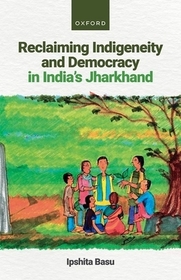
Reclaiming Indigeneity and Democracy in India's Jharkhand
- Publisher's listprice GBP 80.00
-
38 220 Ft (36 400 Ft + 5% VAT)
The price is estimated because at the time of ordering we do not know what conversion rates will apply to HUF / product currency when the book arrives. In case HUF is weaker, the price increases slightly, in case HUF is stronger, the price goes lower slightly.
- Discount 10% (cc. 3 822 Ft off)
- Discounted price 34 398 Ft (32 760 Ft + 5% VAT)
Subcribe now and take benefit of a favourable price.
Subscribe
38 220 Ft

Availability
printed on demand
Why don't you give exact delivery time?
Delivery time is estimated on our previous experiences. We give estimations only, because we order from outside Hungary, and the delivery time mainly depends on how quickly the publisher supplies the book. Faster or slower deliveries both happen, but we do our best to supply as quickly as possible.
Product details:
- Publisher OUP Oxford
- Date of Publication 2 February 2024
- ISBN 9780198884675
- Binding Hardback
- No. of pages238 pages
- Size 222x147x18 mm
- Weight 432 g
- Language English 484
Categories
Short description:
This book is an timely account of indigenous politics and represents the first-ever attempt to foreground the complex 'political nature' of social justice claims-making in a democracy such as India.
MoreLong description:
Created in 2000 following a long-standing regional movement, Jharkhand-the land of forests-represents an important experiment in regional autonomy and self-determination for indigenous communities in a postcolonial democracy. Over two decades, Jharkhand has experienced a volatile political environment as competing political groups have mobilised indigenous subaltern communities for different ends. In Reclaiming Indigeneity and Democracy in India's Jharkhand, Ipshita Basu contributes to scholarship on critical social justice and indigeneity by highlighting 'relations of justification' as a central feature of group-based claims-making for social groups identifying with indigeneity in diverse ways. Specifically, the book focuses on reclaiming political recognition for Adivasis within the contemporary dynamics of majoritarian populism and the market economy. Uniting perspectives from philosophy (social justice), politics (democracy and public reasoning), and culture studies (identity), and based on ethnographic and archival research, the author indicates that when 'relations' are at the epicentre of claims-making, expressive attachments determine political activism over the instrumental choices that groups are compelled to make in the context of large power differentials. This book is a timely account of indigenous politics and is an attempt to foreground the complex 'political nature' of social justice claims-making in a democracy such as India.
MoreTable of Contents:
Introduction: Indigenous Subalterns and the 'Politics' of Recognition
Relations of Justification and Democratic Structures
The Politics of Names and Numbers in Jharkhand
The Instrumental Politics of the Hindu Right in Jharkhand
The Dilemmas of Regional Parties in Jharkhand
Maoists and the Costs of Indigenous Subaltern Citizenship
Conclusion

