

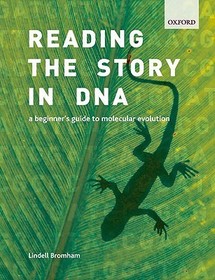
Reading the Story in DNA
A beginner's guide to molecular evolution
- Publisher's listprice GBP 29.99
-
13 540 Ft (12 895 Ft + 5% VAT)
The price is estimated because at the time of ordering we do not know what conversion rates will apply to HUF / product currency when the book arrives. In case HUF is weaker, the price increases slightly, in case HUF is stronger, the price goes lower slightly.
- Discount 10% (cc. 1 354 Ft off)
- Discounted price 12 186 Ft (11 606 Ft + 5% VAT)
Subcribe now and take benefit of a favourable price.
Subscribe
13 540 Ft

Availability
Out of print
Why don't you give exact delivery time?
Delivery time is estimated on our previous experiences. We give estimations only, because we order from outside Hungary, and the delivery time mainly depends on how quickly the publisher supplies the book. Faster or slower deliveries both happen, but we do our best to supply as quickly as possible.
Product details:
- Publisher Oxford University Press
- Date of Publication 7 August 2008
- ISBN 9780199290918
- Binding Paperback
- No. of pages384 pages
- Size 245x188x17 mm
- Weight 837 g
- Language English
- Illustrations numerous colour and black-and-white photographs, numerous figures 0
Categories
Short description:
Reading the story in DNA is a beginner's guide to molecular evolution, introducing a variety of applications of molecular data in evolutionary biology to give students the understanding they need to make intelligent choices when seeking bioinformatic answers to biological questions.
MoreLong description:
The world is full of DNA. The salad in your sandwich, the pollen in the air, even the dirt on your shoes contains DNA from which a vast amount of information can be gained, including the identification of individuals and species, the structure and distribution of populations, the origins of lineages and the pace and mechanisms of evolutionary change.
Reading the story in DNA is a beginner's guide to molecular evolution, and is the perfect companion on the journey to a proper understanding of molecular data.
The central theme of the book is that in order to get ecological or evolutionary information out of molecular data, you must understand the way that the molecular data evolves and the influence that the assumptions you make have on the answers you get.
The book blends beautifully clear explanations with cutting-edge examples from the research literature, drawing on the fields of biodiversity, conservation biology, epidemiology, phylogeography, evolutionary development and ancient DNA to explore topics such as molecular evolutionary theory, phylogenetics, molecular clocks, detecting selection and recombination, and identifying individuals from molecular data.
Technical detail is set apart from the main text, allowing the student to approach the material in different ways: read only the text and skip the finer details, use the text to understand the technical details or vice versa, or identify key case studies and read the concepts and methods particular to that case.
The use of 'bioinformatic' analyses has revolutionized biology, and there are now few areas of evolution and ecology that remain untouched by molecular data. Today's biology students and researchers need to be familiar with the application of molecular data to answering evolutionary questions. But the most pressing question is usually: "Where do I start?!" This book is the answer.
Online Resource Centre:
The Online Resource Centre features:
- Figures from the book in electronic format, ready to download
- Tutorial exercises and practical projects
For students:
- Annotated weblinks
- Flashcard glossary
- Topical updates: links to relevant journal articles and websites that describe advancements in the field since the book's publication
This is a thoroughly engaging beginners textbook on molecular evolution. Bromhams use of modern, colorful examples rather than equations will capture both the attention and the imagination of readers, providing a clear and thorough introduction into a highly sophisticated field without requiring advanced mathematical knowledge.
The Quarterly Review of Biology
Table of Contents:
The Story in DNA: what kind of information can I get from DNA?
The Immortal Germline: how do I get DNA samples?
We are all Mutants: how do I identify individuals?
Endless Copies: how do I amplify DNA?
Descent with Modification: how do I detect selection?
Origin of Species: how do I align sequences?
Tree of Life: how do I construct a phylogeny?
Tempo and Mode: how do I estimate molecular dates?
You are a scientist: what do I do now?

