

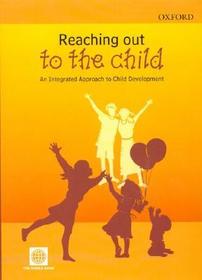
Reaching out to the Child
An Integrated Approach to Child Development
- Publisher's listprice GBP 14.99
-
6 767 Ft (6 445 Ft + 5% VAT)
The price is estimated because at the time of ordering we do not know what conversion rates will apply to HUF / product currency when the book arrives. In case HUF is weaker, the price increases slightly, in case HUF is stronger, the price goes lower slightly.
- Discount 10% (cc. 676 Ft off)
- Discounted price 6 091 Ft (5 801 Ft + 5% VAT)
Subcribe now and take benefit of a favourable price.
Subscribe
6 767 Ft

Availability
Uncertain availability. Please turn to our customer service.
Why don't you give exact delivery time?
Delivery time is estimated on our previous experiences. We give estimations only, because we order from outside Hungary, and the delivery time mainly depends on how quickly the publisher supplies the book. Faster or slower deliveries both happen, but we do our best to supply as quickly as possible.
Product details:
- Publisher OUP India
- Date of Publication 13 January 2005
- ISBN 9780195673326
- Binding Paperback
- No. of pages160 pages
- Size 275x212x10 mm
- Weight 635 g
- Language English
- Illustrations numerous colour illustrations, tables, figures and text boxes 0
Categories
Short description:
This report focuses on Indian children and their physical, social, emotional, intellectual and educational development.
MoreLong description:
The future of India rests in the well-being of her children—across income group, geographical location, gender, and community. Ensuring that every child grows up in an environment conducive to her development is important for the country's overall progress and advancement.
The report argues for an integrated and life cycle approach to child development and basic education of children. It finds that while India has in the last few decades made considerable progress in ensuring child survival and basic education, there is much that remains to be done. The report illustrates using quantitative and qualitative data that such major indices of the Indian child's development as maternal mortality, birthweight, immunization, nutrition level, and basic
education,
as also existing policy interventions for the child, compare unfavourably with other developing countries.
In this context, the report develops a conceptual framework for integrated child developing using case studies on the s ta tus of children in India. It links the optimum delivery of services with an analysis of public expenditure on elementary education. It takes a holistic and multi-sectoral approach to child development focusing on the 'total child', in the real life context of family, community, and existing social systems. The report also prescribes specific guidelines to operationalize
an integrated approach for ensuring the successful completion of universal primary education—the best indicator of all-round development of the Indian child.
Conceptualized and written by eminent early childhood development experts in consultation with noted Indian professionals, this report is essential for social scientists, scholars and researchers in the field of child
development
and childhood studies, educationists, policy-planners, and activists.
Table of Contents:
Acknowledgements
Contents
Preface, Executive Summary
Introduction - Development for a Lifetime
The Conceptual Framework - Towards an Integrated Approach
The Real Picture - The Status of the Indian Child
Existing Interventions - Are they Reaching the Child?
Underwriting the Child's Development - Public Spending on the Child
The Way Ahead - Major Concerns and Recommendations
Appendix: Members of the Technical Committee and Core Committee
Bibliography

