

- Publisher's listprice GBP 17.00
-
7 675 Ft (7 310 Ft + 5% VAT)
The price is estimated because at the time of ordering we do not know what conversion rates will apply to HUF / product currency when the book arrives. In case HUF is weaker, the price increases slightly, in case HUF is stronger, the price goes lower slightly.
- Discount 10% (cc. 767 Ft off)
- Discounted price 6 908 Ft (6 579 Ft + 5% VAT)
Subcribe now and take benefit of a favourable price.
Subscribe
7 675 Ft

Availability
Uncertain availability. Please turn to our customer service.
Why don't you give exact delivery time?
Delivery time is estimated on our previous experiences. We give estimations only, because we order from outside Hungary, and the delivery time mainly depends on how quickly the publisher supplies the book. Faster or slower deliveries both happen, but we do our best to supply as quickly as possible.
Product details:
- Publisher OUP Oxford
- Date of Publication 12 June 2003
- ISBN 9780195158014
- Binding Paperback
- No. of pages368 pages
- Size 227x145x23 mm
- Weight 485 g
- Language English
- Illustrations numerous halftones 0
Categories
Short description:
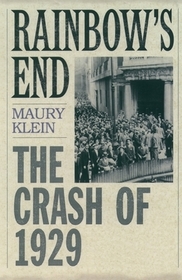
The Crash of '29 is one of the key moments in American, and indeed world history. This gifted narrative historian addresses its effects on both business and society, and recreates the coming together of economic forces culminating in this disaster.
MoreLong description:
Few single events have affected business and society in the US so profoundly, and in such a short time. There have also been few books that address both these elements of the crash together, and very little published on the subject in the past decade. In this book, a gifted narrative historian with extensive background in the history of business and finance will put into perspective the many conflicting theories of what caused the crash, what role speculation did or did not play,
whether or not it could have been avoided, and what role it played in bringing on the depression.
The crash itself will be the climax of the narrative. Most of the book will concentrate on the decade before the crash, outlining the heavy bull market, and describing an era of unprecedented technological development, optimism, and expanding wealth. This decade saw the burgeoning of mass society and a popular culture driven by media and advertising, and a heady free market marked by unregulated banking and credit systems, and get-rich-quick schemes. Klein argues that the stock market crash
marked a turning point in American history where the failure of self-regulating individualism led to an overhaul of the financial system and much more government regulation. It threw into question the beliefs in the American dream spawned by the 20s and preceded a preiod of deep depression, not only
economically, but in regard to the most fundamental American values. The narrative will use a variety of people, developments, and events to illuminate these themes: Jack Morgan, Richard Whitney, Joseph Kennedy, Charles Mitchell, Herbert Hoover, John J. Raskob, and Alexander J. Noyes.

