

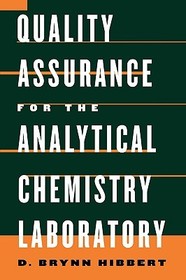
Quality Assurance in the Analytical Chemistry Laboratory
- Publisher's listprice GBP 62.00
-
27 993 Ft (26 660 Ft + 5% VAT)
The price is estimated because at the time of ordering we do not know what conversion rates will apply to HUF / product currency when the book arrives. In case HUF is weaker, the price increases slightly, in case HUF is stronger, the price goes lower slightly.
- Discount 10% (cc. 2 799 Ft off)
- Discounted price 25 194 Ft (23 994 Ft + 5% VAT)
Subcribe now and take benefit of a favourable price.
Subscribe
27 993 Ft

Availability
printed on demand
Why don't you give exact delivery time?
Delivery time is estimated on our previous experiences. We give estimations only, because we order from outside Hungary, and the delivery time mainly depends on how quickly the publisher supplies the book. Faster or slower deliveries both happen, but we do our best to supply as quickly as possible.
Product details:
- Publisher OUP USA
- Date of Publication 5 April 2007
- ISBN 9780195162134
- Binding Paperback
- No. of pages320 pages
- Size 235x166x15 mm
- Weight 467 g
- Language English
- Illustrations 112 line illus. 0
Categories
Short description:
This book takes the reader through all aspects of quality assurance, from the statistical basics and quality control tools to becoming accredited to international standards. The latest understanding of concepts such as measurement uncertainty, metrological traceability and interlaboratory studies are explained for a working chemist or her customer.
MoreLong description:
Analytical chemical results touch everyones lives can we eat the food? do I have a disease? did the defendant leave his DNA at the crime scene? should I invest in that gold mine? When a chemist measures something how do we know that the result is appropriate? What is fit for purpose in the context of analytical chemistry? Many manufacturing and service companies have embraced traditional statistical approaches to quality assurance, and these have been adopted by analytical chemistry laboratories. However the right chemical answer is never known, so there is not a direct parallel with the manufacture of ball bearings which can be measured and assessed. The customer of the analytical services relies on the quality assurance and quality control procedures adopted by the laboratory. It is the totality of the QA effort, perhaps first brought together in this text, that gives the customer confidence in the result. QA in the Analytical Chemistry Laboratory takes the reader through all aspects of QA, from the statistical basics and quality control tools to becoming accredited to international standards. The latest understanding of concepts such as measurement uncertainty and metrological traceability are explained for a working chemist or her client. How to design experiments to optimize an analytical process is included, together with the necessary statistics to analyze the results. All numerical manipulation and examples are given as Microsoft Excel spreadsheets that can be implemented on any personal computer. Different kinds of interlaboratory studies are explained, and how a laboratory is judged in proficiency testing schemes is described. Accreditation to ISO 17025 or OECD GLP is nearly obligatory for laboratories of any pretension to quality. Here the reader will find an introduction to the requirements and philosophy of accreditation. Whether completing a degree course in chemistry or working in a busy analytical laboratory, this book is a single source for an introduction into quality assurance.
The book is well written with many personal touches, stories, anecdotes and unusual analogies introducing a lighter note. Chemistry World, November 2007.

