

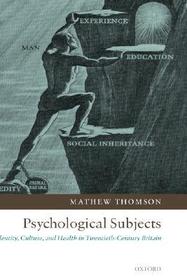
Psychological Subjects
Identity, Culture, and Health in Twentieth-Century Britain
- Publisher's listprice GBP 210.00
-
100 327 Ft (95 550 Ft + 5% VAT)
The price is estimated because at the time of ordering we do not know what conversion rates will apply to HUF / product currency when the book arrives. In case HUF is weaker, the price increases slightly, in case HUF is stronger, the price goes lower slightly.
- Discount 10% (cc. 10 033 Ft off)
- Discounted price 90 295 Ft (85 995 Ft + 5% VAT)
Subcribe now and take benefit of a favourable price.
Subscribe
100 327 Ft

Availability
printed on demand
Why don't you give exact delivery time?
Delivery time is estimated on our previous experiences. We give estimations only, because we order from outside Hungary, and the delivery time mainly depends on how quickly the publisher supplies the book. Faster or slower deliveries both happen, but we do our best to supply as quickly as possible.
Product details:
- Publisher OUP Oxford
- Date of Publication 25 May 2006
- ISBN 9780199287802
- Binding Hardback
- No. of pages352 pages
- Size 242x162x24 mm
- Weight 677 g
- Language English 0
Categories
Short description:
Psychological Subjects is a broad-ranging and original historical study of how psychological thinking developed as a feature of life in twentieth-century Britain. Ranging from the excitement about a new age at the start of the century to the permissive society of the 1970s, it offers us a new picture of how Britons of the period came to think about themselves and their world psychologically.
MoreLong description:
This is a history of how twentieth-century Britons came to view themselves and their world in psychological terms, and how this changed over time. It examines the extent to which psychological thought and practice could mediate, not just understanding of the self, but also a wide range of social and economic, political, and ethical issues that rested on assumptions about human nature. In doing so, it brings together high and low psychological cultures; it focuses not just on health, but also on education, economic life, and politics; and it reaches from the start of the century right up to the 1970s.
Mathew Thomson highlights the intense excitement surrounding psychology at the start of the century, and its often highly unorthodox expression in thought and practice. He argues that the appeal of psychological thinking has been underestimated in the British context, partly because its character has been misconstrued. Psychology found a role because, rather than shattering values, it offered them new life. The book considers the extent to which such an ethical and social psychological subjectivity survived the challenges of an industrial civilization, a crisis in confidence regarding human nature wrought by war and political extremism, and finally the emergence of a permissive society. It concludes that many of our own assumptions about the route to psychological modernity - centred on the rise of individualism and interiority, and focusing on the liberation of emotion, and on talk, relationships, and sex - need substantial revision, or at least setting alongside a rather different path when it comes to the Britain of 1900-70.
Psychological Subjects is an important book...a vast and well-documented study. No historian of psychological ideas and practice in Britain, or those broadly interested in the self and the democratic subject in modern industrial society, can afford to ignore this major work
Table of Contents:
Introduction
I. Psychologies of the New Age
Practical Psychology
Reframing the Discipline
After the New Age
II. Prospects and Problems
Psychology and Education
Psychology and the Problem of Industrial Civilization
Medicine and the Psychological
III. Ends
Psychology and the Mid-Century Crisis
Towards the Permissive Society
Conclusion
Bibliography
Index

