

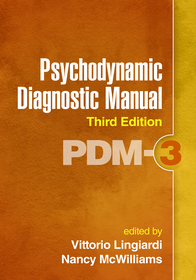
Psychodynamic Diagnostic Manual, Third Edition
PDM-3
- Publisher's listprice GBP 70.99
-
32 051 Ft (30 525 Ft + 5% VAT)
The price is estimated because at the time of ordering we do not know what conversion rates will apply to HUF / product currency when the book arrives. In case HUF is weaker, the price increases slightly, in case HUF is stronger, the price goes lower slightly.
- Discount 20% (cc. 6 410 Ft off)
- Discounted price 25 641 Ft (24 420 Ft + 5% VAT)
- Discount is valid until: 30 June 2026
Subcribe now and take benefit of a favourable price.
Subscribe
28 846 Ft

Availability
Estimated delivery time: In stock at the publisher, but not at Prospero's office. Delivery time approx. 3-5 weeks.
Not in stock at Prospero.
Why don't you give exact delivery time?
Delivery time is estimated on our previous experiences. We give estimations only, because we order from outside Hungary, and the delivery time mainly depends on how quickly the publisher supplies the book. Faster or slower deliveries both happen, but we do our best to supply as quickly as possible.
Product details:
- Edition number 3
- Publisher Guilford Press
- Date of Publication 17 February 2026
- ISBN 9781462558711
- Binding Paperback
- No. of pages1058 pages
- Size 254x178 mm
- Weight 1880 g
- Language English 790
Categories
Long description:
Fully updated and restructured with 70% new material, PDM-3 presents important advances in multiaxial mental health diagnosis from a psychodynamic perspective, in dialogue with neuroscientific and cognitive-behavioral perspectives. Used worldwide, this authoritative manual offers an empirically based, clinically useful alternative or supplement to DSM and ICD descriptive and symptom-oriented diagnoses. PDM-3 guides the practitioner to develop a multilayered dimensional understanding of each patient, leading to a rich case formulation and flexible treatment plan. Leading international experts systematically address personality functioning, mental capacities, and symptomatic impairment in infancy, childhood, adolescence, adulthood, and old age, including jargon-free descriptions and clinical examples. The companion website provides additional, in depth case illustrations and five downloadable and reproducible PDM-derived rating scales.
New to This Edition
- Restructured to follow development chronologically.
- Conceptual refinements, updated assessment tools, and expanded case material.
- Chapters on the transition from infancy to childhood and from adolescence to adulthood.
- Chapters on psychological experiences throughout the lifespan that are not captured by a diagnosis, but may require clinical attention.
Supporting associations include the International Psychoanalytical Association, Division 39 of the American Psychological Association, the American Psychoanalytic Association, the International Association for Relational Psychoanalysis & Psychotherapy, the American Association for Psychoanalysis in Clinical Social Work, and other organizations.
PDM-2 won the American Board and Academy of Psychoanalysis Book Prize (Clinical Category)
“Psychoanalysis is often akin to a Tower of Babel, with so many ways to describe a patient but without a unifying language that lets analysts around the world share and learn from each other’s experiences. PDM offers a creative solution to this dilemma and an essential guiding frame for those learning the craft. It also offers a creative functional counterpoint to the push for categorical diagnoses, which too often overlook the rich nuance in an individual patient’s struggles and needs. That PDM is now in its third edition speaks to how essential a role it already plays in sustaining and growing psychoanalytic practice around the world.”--Linda C. Mayes, MD, Arnold Gesell Professor of Child Psychiatry, Pediatrics, and Psychology and Chair, Yale Child Study Center, Yale School of Medicine
“The PDM is far more useful in clinical practice than the DSM or ICD. Psychopathologies simply cannot be adequately conceptualized in purely nomothetic terms; to ignore the idiographic is to ignore the most essential feature of the mind--namely, that it is subjective. The inclusion of some neuropsychoanalytic constructs in this edition is a particularly welcome development.”--Mark Solms, PhD, Co-Chair, International Neuropsychoanalysis Society
“A landmark achievement. Fully revised, PDM-3 offers a comprehensive lifespan framework that captures the complexity of human functioning through a dimensional, person-centered lens. It integrates contemporary research--from neuroscience and outcome studies to cultural and developmental psychology--while remaining grounded in core psychodynamic traditions such as object relations, ego psychology, and relational theory. PDM-3 adds vital clinical nuance to classification by emphasizing subjective experience, developmental context, and therapeutic relevance, and by incorporating both nomothetic and idiographic perspectives. Ideal for graduate training in diagnosis and assessment, PDM-3 is clinically meaningful and empirically grounded, revitalizing psychodynamic assessment for today’s mental health landscape.”--Peter Lilliengren, PhD, Department of Psychology, Stockholm University, Sweden
“PDM-3 is an extraordinary collaborative achievement, with chapter editors and consultants who are among the most talented people in our profession. The volume champions psychodynamic thinking, including ego psychology, object relations, self psychology, and relational psychoanalysis. With sensitivity to developmental phases, culture, context, and diversity, PDM-3 makes diagnosis clinically meaningful beyond the narrow categories of the DSM, and includes dialogue with cognitive science and neuroscience. The third edition is easy to read, is organized chronologically beginning with infancy, and includes more recent empirical literature. This book is an invaluable resource for researchers as well as clinicians.”--Beatrice Beebe, PhD, Clinical Professor, Columbia University Medical Center, New York State Psychiatric Institute-The depth is impressive….Recommended. Upper-level undergraduates through professionals/practitioners. (on the second edition)--Choice Reviews, 11/1/2017Æ’Æ’No matter what your theoretical framework, this book and its ideas will work for you. Truly a mind-opening experience, and one which makes clinicians stop and think about their current therapeutic orientation. A must read for open-minded clinicians willing to go beyond the confines of the current diagnostic models. *****! (on the second edition)--Doody's Review Service, 7/28/2017 More
Table of Contents:
Introduction, Vittorio Lingiardi & Nancy McWilliams
I. Infancy and Early Childhood
1. Mental Health and Developmental Disorders in Infancy and Early Childhood--IEC 0–3, Anna Maria Speranza & Miriam Steele
2. From Infancy to Childhood, Anna Maria Speranza
II. Childhood
3. Profile of Mental Functioning in Childhood--MC Axis, Norka Malberg, Anna Maria Speranza, & Alexandro Fortunato
4. Levels of Emerging Personality Patterns and Difficulties in Childhood--PC Axis, Norka Malberg, Anna Maria Speranza, & Alexandro Fortunato
5. Child Symptom Patterns: The Subjective Experience--SC Axis, Anna Maria Speranza, Norka Malberg, & Alexandro Fortunato
6. Psychological Experiences That May Require Clinical Attention in Childhood, Anna Maria Speranza, Alexandro Fortunato, & Norka Malberg
III. Adolescence
7. Profile of Mental Functioning in Adolescents--MA Axis, Annalisa Tanzilli & Norka Malberg
8. Emerging Personality Styles and Disorders in Adolescence--PA Axis, Annalisa Tanzilli & Carla Sharp
9. Adolescent Symptom Patterns: The Subjective Experience--SA Axis, Annalisa Tanzilli & Mario Speranza
10. Psychological Experiences That May Require Clinical Attention in Adolescence, Annalisa Tanzilli & Guido Giovanardi
11. Psychodynamic Diagnostic Assessment in the Early Adult Years, Annalisa Tanzilli
IV. Adulthood
12. Personality Styles and Disorders--P Axis, Nancy McWilliams & Jonathan Shedler
13. Profile of Mental Functioning--M Axis, Vittorio Lingiardi, Laura Muzi, & Robert F. Bornstein
14. Symptom Patterns: The Subjective Experience--S Axis, Emanuela Mundo,Laura Muzi, & Vittorio Lingiardi
15. Psychological Experiences That May Require Clinical Attention, Vittorio Lingiardi & Nancy McWilliams
V. Older Adults
16. When Does Later Life Begin?, Franco Del Corno & Daniel Plotkin
17. Profile of Mental Functioning in Older Adults--MOA Axis, Franco Del Corno & Daniel Plotkin
18. Personality Styles and Disorders in Older Adults--POA Axis, Franco Del Corno & Daniel Plotkin
19. Symptom Patterns in Older Adults: The Subjective Experience--SOA Axis, Franco Del Corno & Daniel Plotkin
20. Psychological Experiences That May Require Clinical Attention in Older Adults, Franco Del Corno & Daniel Plotkin
VI. Assessment Using PDM-3
21. Assessment within the PDM-3 Framework: The Psychodiagnostic Charts (PDCs), Vittorio Lingiardi & Nancy McWilliams
Index

