

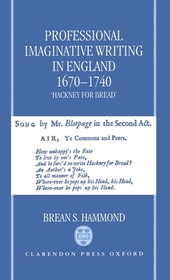
Professional Imaginative Writing in England, 1670-1740
`Hackney for Bread'
- Publisher's listprice GBP 195.00
-
88 042 Ft (83 850 Ft + 5% VAT)
The price is estimated because at the time of ordering we do not know what conversion rates will apply to HUF / product currency when the book arrives. In case HUF is weaker, the price increases slightly, in case HUF is stronger, the price goes lower slightly.
- Discount 10% (cc. 8 804 Ft off)
- Discounted price 79 238 Ft (75 465 Ft + 5% VAT)
Subcribe now and take benefit of a favourable price.
Subscribe
88 042 Ft

Availability
printed on demand
Why don't you give exact delivery time?
Delivery time is estimated on our previous experiences. We give estimations only, because we order from outside Hungary, and the delivery time mainly depends on how quickly the publisher supplies the book. Faster or slower deliveries both happen, but we do our best to supply as quickly as possible.
Product details:
- Publisher Clarendon Press
- Date of Publication 6 March 1997
- ISBN 9780198112990
- Binding Hardback
- No. of pages358 pages
- Size 226x146x25 mm
- Weight 555 g
- Language English 0
Categories
Short description:
Professional Imaginative Writing in England, 1670-1740 provides a much-needed overview of the social, political, economic, and institutional context within which imaginative writing developed during the late 17th and early 18th century. It was in this period that such writing became a widely-consumed commodity, as literacy improved, women entered the literary workplace in considerable numbers, newspapers and periodicals emerged as distinct forms, and the novel became a recognized literary form.
MoreLong description:
Professional Imaginative Writing in England, 1670-1740 sets out to provide an overview of the social, political, economic, and institutional context within which imaginative writing developed during the late 17th and 18th century. It was in this period that such writing became a widely-consumed commodity, as literacy improved, women entered the literary workplace in considerable numbers, newspapers and periodicals emerged as distinct forms, and the novel became a recognized literary form.
Hammond's style, brisk and personal, is far from conventional academic dryness, and engaging throughout. Hoping to lay the foundations for a new biography of writing in his chosen period, he succeeds brilliantly.

