

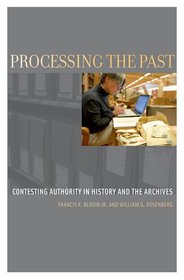
Processing the Past
Changing Authorities in History and the Archives
Series: Oxford Series on History and Archives;
- Publisher's listprice GBP 120.00
-
54 180 Ft (51 600 Ft + 5% VAT)
The price is estimated because at the time of ordering we do not know what conversion rates will apply to HUF / product currency when the book arrives. In case HUF is weaker, the price increases slightly, in case HUF is stronger, the price goes lower slightly.
- Discount 10% (cc. 5 418 Ft off)
- Discounted price 48 762 Ft (46 440 Ft + 5% VAT)
Subcribe now and take benefit of a favourable price.
Subscribe
54 180 Ft

Availability
printed on demand
Why don't you give exact delivery time?
Delivery time is estimated on our previous experiences. We give estimations only, because we order from outside Hungary, and the delivery time mainly depends on how quickly the publisher supplies the book. Faster or slower deliveries both happen, but we do our best to supply as quickly as possible.
Product details:
- Publisher OUP USA
- Date of Publication 10 March 2011
- ISBN 9780199740543
- Binding Hardback
- No. of pages272 pages
- Size 165x236x27 mm
- Weight 519 g
- Language English 0
Categories
Short description:
This lively book explores the changes taking place in history and the archives as a result of new concepts, practices, and technologies. Among other issues, it raises the question of what future historical archives will be like if scholars and archivists cannot understand each others' work.
MoreLong description:
Processing the Past explores the dramatic changes taking place in historical understanding and archival management, and hence the relations between historians and archivists. Written by an archivist and a historian, it shows how these changes have been brought on by new historical thinking, new conceptions of archives, changing notions of historical authority, modifications in archival practices, and new information technologies. The book takes an "archival turn" by situating archives as subjects rather than places of study, and examining the increasingly problematic relationships between historical and archival work.
The book sets the background to these changes by showing how nineteenth- and early twentieth-century historians and archivists in Europe and North American came to occupy the same conceptual and methodological space. For both, authoritative history was based on authoritative archives and mutual understandings of scientific research. The authors then show how these connections changed as historians began to ask questions not easily answered by traditional documentation, and archivists began to confront an unmanageable increase in the amount of material they processed and the challenges of new electronic technologies.
The book situates these changes in a review of contemporary historical concepts and archival practices. The authors contend that historians and archivists have divided into two entirely separate professions with distinct conceptual frameworks, training, and purposes, as well as different understandings of the authorities that govern their work. Processing the Past moves toward bridging this divide by speaking in one voice to these very different audiences as well as to general readers.
The book concludes by raising the worrisome question of what future historical archives might be like if historical scholars and archivists no longer understand each other, and indeed, whether their now different notions of what is archival and historical will ever again be joined.
a challenging and stimulating book
Table of Contents:
Authoritative History and Authoritative Archives
The Turn Away from Historical Authority in the Archives
Archival Authorities and New Technologies
The Turn Away from Archival Authority in History
Archival Essentialism and the Archival Divide
The Social Memory Problem
Contested Archives, Contested Sources
The Archivist as Activist in the Production of (Historical) Knowledge
Rethinking Archival Politics: Trust, Truth, and the Law
Archives and the Cyberinfrastructure
Can Archives and History Reconnect: Bridging the Archival Divide

