

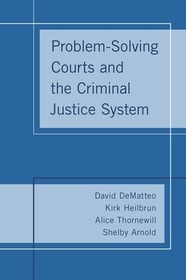
Problem-Solving Courts and the Criminal Justice System
- Publisher's listprice GBP 80.00
-
38 220 Ft (36 400 Ft + 5% VAT)
The price is estimated because at the time of ordering we do not know what conversion rates will apply to HUF / product currency when the book arrives. In case HUF is weaker, the price increases slightly, in case HUF is stronger, the price goes lower slightly.
- Discount 10% (cc. 3 822 Ft off)
- Discounted price 34 398 Ft (32 760 Ft + 5% VAT)
Subcribe now and take benefit of a favourable price.
Subscribe
38 220 Ft

Availability
printed on demand
Why don't you give exact delivery time?
Delivery time is estimated on our previous experiences. We give estimations only, because we order from outside Hungary, and the delivery time mainly depends on how quickly the publisher supplies the book. Faster or slower deliveries both happen, but we do our best to supply as quickly as possible.
Product details:
- Publisher OUP USA
- Date of Publication 14 October 2019
- ISBN 9780190844820
- Binding Hardback
- No. of pages264 pages
- Size 239x157x27 mm
- Weight 522 g
- Language English 0
Categories
Short description:
Problem-Solving Courts and the Criminal Justice System provides professionals and students in the fields of mental health, criminal justice, law, and related fields with a comprehensive foundation of information related to problem-solving courts and the role such courts play in reforming the United States criminal justice system. The book is a timely response to the rapidly changing landscape of that system, relatively recent development of problem-solving courts, and the ongoing paradigm shift away from punishment and toward restorative justice.
MoreLong description:
Problem-solving courts provide judicially supervised treatment for behavioral health needs commonly found among criminal offenders, including substance abuse and mental health disorders, and they treat a variety of offender populations. These courts employ a team-based approach consisting of a judge, defense attorney, prosecutor, and treatment providers, representing a significant paradigm shift in how the justice system treats offenders with special needs. Despite the proliferation of problem-solving courts, there remains some uncertainty about how they function, how effective they are, and the most promising ways to implement problem-solving justice.
Problem-Solving Courts and the Criminal Justice System provides a comprehensive foundation of knowledge related to problem-solving courts and the role they play in the United States criminal justice system. The book begins with an overview that explores precipitating factors in these courts' development, relevant political influence, and their history, purposes, benefits, and drawbacks, followed by a detailed discussion of specific types of problem solving courts, including drug courts, mental health courts, and veterans courts, among many others. Next a review of the legal and ethical considerations of alternative methods to standard prosecution is complemented by an examination of the methodological challenges faced by researchers when attempting to study the effectiveness of problem-solving courts. The book concludes with a discussion of future directions in terms of research, practice, and policy relating to these courts in the United States. Problem-Solving Courts and the Criminal Justice System is appropriate for professionals, researchers, and students in the fields of mental health, criminal justice, and law.
Themost thorough examination of specialty courts published to date, this volume will be an ideal resource for lawmakers, criminal justice administrators, and others involved in the US court system, as well as students of law,criminology, criminal justice, political science, sociology, and psychology.
Table of Contents:
1. Current Issues in the Criminal Justice System: Introduction to Problem-Solving Courts
2. Alternatives to Standard Prosecution: Problem-Solving Courts
3. Clinical Interventions in Problem-Solving Courts
4. Drug Courts
5. Mental Health Courts
6. Other Specialty Courts
7. Reentry Courts
8. Methodological Challenges in Researching Problem-Solving Courts
9. Ethical and Legal Considerations in Problem-Solving Courts
10. Problems-Solving Courts: Present Status and Future Directions
List of Cases
References
Index

