

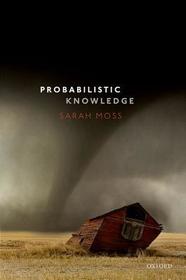
Probabilistic Knowledge
- Publisher's listprice GBP 89.00
-
42 519 Ft (40 495 Ft + 5% VAT)
The price is estimated because at the time of ordering we do not know what conversion rates will apply to HUF / product currency when the book arrives. In case HUF is weaker, the price increases slightly, in case HUF is stronger, the price goes lower slightly.
- Discount 10% (cc. 4 252 Ft off)
- Discounted price 38 268 Ft (36 446 Ft + 5% VAT)
Subcribe now and take benefit of a favourable price.
Subscribe
42 519 Ft

Availability
printed on demand
Why don't you give exact delivery time?
Delivery time is estimated on our previous experiences. We give estimations only, because we order from outside Hungary, and the delivery time mainly depends on how quickly the publisher supplies the book. Faster or slower deliveries both happen, but we do our best to supply as quickly as possible.
Product details:
- Publisher OUP Oxford
- Date of Publication 22 February 2018
- ISBN 9780198792154
- Binding Hardback
- No. of pages282 pages
- Size 242x163x23 mm
- Weight 586 g
- Language English 0
Categories
Short description:
Sarah Moss argues that in addition to full beliefs, credences can constitute knowledge. She introduces the notion of probabilistic content and shows how it plays a central role not only in epistemology, but in the philosophy of mind and language. Just you can believe and assert propositions, you can believe and assert probabilistic contents.
MoreLong description:
Traditional philosophical discussions of knowledge have focused on the epistemic status of full beliefs. Sarah Moss argues that in addition to full beliefs, credences can constitute knowledge. For instance, your 0.4 credence that it is raining outside can constitute knowledge, in just the same way that your full beliefs can. In addition, you can know that it might be raining, and that if it is raining then it is probably cloudy, where this knowledge is not knowledge of propositions, but of probabilistic contents.
The notion of probabilistic content introduced in this book plays a central role not only in epistemology, but in the philosophy of mind and language as well. Just as tradition holds that you believe and assert propositions, you can believe and assert probabilistic contents. Accepting that we can believe, assert, and know probabilistic contents has significant consequences for many philosophical debates, including debates about the relationship between full belief and credence, the semantics of epistemic modals and conditionals, the contents of perceptual experience, peer disagreement, pragmatic encroachment, perceptual dogmatism, and transformative experience. In addition, accepting probabilistic knowledge can help us discredit negative evaluations of female speech, explain why merely statistical evidence is insufficient for legal proof, and identify epistemic norms violated by acts of racial profiling. Hence the central theses of this book not only help us better understand the nature of our own mental states, but also help us better understand the nature of our responsibilities to each other.
Table of Contents:
The case for probabilistic contents
The case for probabilistic assertion
Epistemic modals and probability operators
Indicative conditionals
The case for probabilistic knowledge
Factivity
Skepticism
Knowledge and belief
Knowledge and action
Knowledge and persons
Appendix: A formal semantics for epistemic vocabulary

