

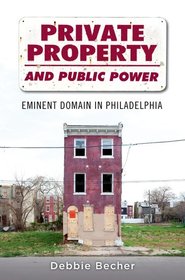
Private Property and Public Power
Eminent Domain in Philadelphia
- Publisher's listprice GBP 137.50
-
62 081 Ft (59 125 Ft + 5% VAT)
The price is estimated because at the time of ordering we do not know what conversion rates will apply to HUF / product currency when the book arrives. In case HUF is weaker, the price increases slightly, in case HUF is stronger, the price goes lower slightly.
- Discount 10% (cc. 6 208 Ft off)
- Discounted price 55 873 Ft (53 213 Ft + 5% VAT)
Subcribe now and take benefit of a favourable price.
Subscribe
62 081 Ft

Availability
printed on demand
Why don't you give exact delivery time?
Delivery time is estimated on our previous experiences. We give estimations only, because we order from outside Hungary, and the delivery time mainly depends on how quickly the publisher supplies the book. Faster or slower deliveries both happen, but we do our best to supply as quickly as possible.
Product details:
- Publisher OUP USA
- Date of Publication 18 September 2014
- ISBN 9780199322541
- Binding Hardback
- No. of pages356 pages
- Size 160x239x25 mm
- Weight 632 g
- Language English
- Illustrations 17 b/w line; 32 b/w halftone 0
Categories
Short description:
This book examines how citizens judge whether government is abusing its power when making use of eminent domain. Debbie Becher argues that neither a belief in property rights nor a desire for growth guide popular evaluations of government legitimacy. Instead, community residents, businesses, government bureaucrats, and politicians all appeal to a shared notion of investment to justify policy.
MoreLong description:
When governments use eminent domain to transfer property between private owners, Americans are outraged-or so most media and academic accounts would have us believe. But these accounts obscure a much more complex reality in American conceptions of property.
In this book, Debbie Becher presents the first comprehensive study of a city's eminent domain acquisitions, exploring how and why the City of Philadelphia took properties between 1992 and 2007 and which takings led to protests. She uses original data-collected from city offices and interviews with over a hundred residents, business owners, community leaders, government representatives, attorneys, and appraisers-to explore how eminent domain really works.
Becher surprises readers by finding that the city took over 4,000 private properties, or one out of every hundred such properties in Philadelphia, during her study period. Furthermore, these takings only rarely provoked opposition-a fact that established views on property are ill-equipped to explain.
To investigate how Americans judge the legitimacy of eminent domain, Becher devotes several chapters to two highly controversial sets of takings for redevelopment projects. The American Street takings were intended to win popular support for redevelopment and initially succeeded in doing so, but it ended as a near total failure and embarrassment. The Jefferson Square takings initially faced vociferous opposition, but they eventually earned residents' approval and became a political showpiece.
Becher uncovers evidence that Americans judge eminent domain through a social conception of property as an investment of value, committed over time, that government is responsible for protecting. This conception has never been described in sociological, legal, political, or economic scholarship, and it stands in stark contrast to the arguments of libertarian and left-leaning activists and academics. But recognizing property as investment, Becher argues, may offer a firm new foundation for more progressive urban policies.
Becher attempts to help the reader navigate the public-private dilemma raised by the use of eminent domain by highlighting the multiple ways in which public and private actions influence the value of private property... [Becher provides] practical insight on how to improve the implementation of eminent domain.
Table of Contents:
Acknowledgments
Abbreviations
Chapter 1. Investment and Government Legitimacy
Chapter 2. The Policy and Politics of Urban Redevelopment
Chapter 3. Rhetoric without a Cause: Beyond Libertarian and Left Cries of Abuse
Chapter 4. American Street I: From Badlands to Promised Lands
Chapter 5. American Street II: From Promises to Protests
Chapter 6. Jefferson Square I: Competing Visions of Investment Protection
Chapter 7. Jefferson Square II: Legitimacy through Reconciled Visions
Chapter 8. Compensating for Property by Recognizing Investments
Chapter 9. The Politics of Property
Bibliography
Appendix 1
Appendix 2
Appendix 3
Notes
Index

