

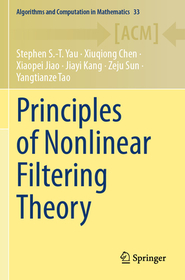
Principles of Nonlinear Filtering Theory
Series: Algorithms and Computation in Mathematics;
- Publisher's listprice EUR 53.49
- Prospero’s price EUR 37.49
-
20 893 Ft (19 898 Ft + 5% VAT)
The price is estimated because at the time of ordering we do not know what conversion rates will apply to HUF / product currency when the book arrives. In case HUF is weaker, the price increases slightly, in case HUF is stronger, the price goes lower slightly.
20 893 Ft

Availability
printed on demand
Why don't you give exact delivery time?
Delivery time is estimated on our previous experiences. We give estimations only, because we order from outside Hungary, and the delivery time mainly depends on how quickly the publisher supplies the book. Faster or slower deliveries both happen, but we do our best to supply as quickly as possible.
Product details:
- Publisher Springer Nature Switzerland
- Date of Publication 18 December 2025
- ISBN 9783031776861
- Binding Paperback
- See also 9783031776830
- No. of pages470 pages
- Size 235x155 mm
- Language English
- Illustrations XIX, 470 p. 1 illus. 647
Categories
Long description:
This text presents a comprehensive and unified treatment of nonlinear filtering theory, with a strong emphasis on its mathematical underpinnings. It is tailored to meet the needs of a diverse readership, including mathematically inclined engineers and scientists at both graduate and post-graduate levels. What sets this book apart from other treatments of the topic is twofold. Firstly, it offers a complete treatment of filtering theory, providing readers with a thorough understanding of the subject. Secondly, it introduces updated methodologies and applications that are crucial in today’s landscape. These include finite-dimensional filters, the Yau-Yau algorithm, direct methods, and the integration of deep learning with filtering problems. The book will be an invaluable resource for researchers and practitioners for years to come.
With a rich historical backdrop dating back to Gauss and Wiener, the exposition delves into the fundamental principles underpinning the estimation of stochastic processes amidst noisy observations—a critical tool in various applied domains such as aircraft navigation, solar mapping, and orbit determination, to name just a few. Substantive exercises and examples given in each chapter provide the reader with opportunities to appreciate applications and ample ways to test their understanding of the topics covered. An especially nice feature for those studying the subject independent of a traditional course setting is the inclusion of solutions to exercises at the end of the book.
The book is structured into three cohesive parts, each designed to build the reader's understanding of nonlinear filtering theory. In the first part, foundational concepts from probability theory, stochastic processes, stochastic differential equations, and optimization are introduced, providing readers with the necessary mathematical background. The second part delves into theoretical aspects of filtering theory, covering topics such as the stochastic partial differential equation governing the posterior density function of the state, and the estimation algebra theory of systems with finite-dimensional filters. Moving forward, the third part of the book explores numerical algorithms for solving filtering problems, including the Yau-Yau algorithm, direct methods, classical filtering algorithms like the particle filter, and the intersection of filtering theory with deep learning.
MoreTable of Contents:
Preface.- I. Preliminary knowledge.- 1. Probability theory.- 2. Stochastic processes.- 3. Stochastic differential equations.- 4. Optimization.- II. Filtering theory.- 5. The filtering equations.- 6. Estimation algebra.- III. Numerical algorithms.- 7. Yau-Yau algorithm.- 8. Direct methods.- 9. Classical filtering methods.- 10. Estimation algorithms based on deep learning.
More
