

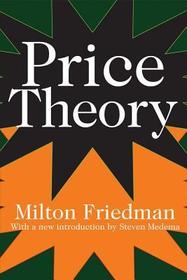
Price Theory
-
GET 10% OFF
- Publisher's listprice GBP 53.99
-
24 376 Ft (23 215 Ft + 5% VAT)
The price is estimated because at the time of ordering we do not know what conversion rates will apply to HUF / product currency when the book arrives. In case HUF is weaker, the price increases slightly, in case HUF is stronger, the price goes lower slightly.
- Discount 10% (cc. 2 438 Ft off)
- Discounted price 21 938 Ft (20 894 Ft + 5% VAT)
21 938 Ft

Availability
printed on demand
Why don't you give exact delivery time?
Delivery time is estimated on our previous experiences. We give estimations only, because we order from outside Hungary, and the delivery time mainly depends on how quickly the publisher supplies the book. Faster or slower deliveries both happen, but we do our best to supply as quickly as possible.
Product details:
- Edition number 1
- Publisher Routledge
- Date of Publication 15 March 2007
- Number of Volumes Paperback
- ISBN 9780202309699
- Binding Paperback
- No. of pages376 pages
- Size 229x152 mm
- Weight 498 g
- Language English 0
Categories
Short description:
Economics is sometimes divided into two parts: positive economics and normative economics
MoreLong description:
Economics is sometimes divided into two parts: positive economics and normative economics. The former deals with how the economic problem is solved, while the latter deals with how the economic problem should be solved. The effects of price or rent control on the distribution of income are problems of positive economics. The desirability of these effects on income distribution is a problem of normative economics.
Within economics, the major division is between monetary theory and price theory. Monetary theory deals with the level of prices in general, with cyclical and other fluctuations in total output, total employment, and the like. Price theory deals with the allocation of resources among different uses, the price of one item relative to another.
Prices do three kinds of things. They transmit information, they provide an incentive to users of resources to be guided by this information, and they provide an incentive to owners of resources to follow this information. Milton Friedman's classic book provides the theoretical underpinning for and understanding of prices.
Economics is not concerned solely with economic problems. It is a social science, and is therefore concerned primarily with those economic problems whose solutions involve the cooperation and interaction of different individuals. It is concerned with problems involving a single individual only insofar as the individual's behavior has implications for or effects upon other individuals. Price Theory is concerned not with economic problems in the abstract, but with how a particular society solves its economic problems.
MoreTable of Contents:
AldineTransaction Introduction, Preface, Preface to Price Theory: A Provisional Text, 1. Introduction, 2. Theory of Demand, 3. The Welfare Effects of Taxes, 4. The Utility Analysis of Uncertainty, 5. The Relationships Between Supply Curves and Cost Curves, 6. The Law of Variable Proportions and a Firm's Cost Curves, 7. Derived Demand, 8. The Theory of Distribution with Fixed Proportions, 9. The Theory of Marginal Productivity and the Demand for Factors of Production, 10. Marginal Productivity Analysis: Some General Issues, 11. The Supply of Factors of Production, 12. Wage Determination and Unemployment, 13. Wages i n Different Occupations, 14. Relation Between the Functional and Personal Distribution of Income, 15. The Size Distribution of Income, 16. Profits, 17. The Theory of Capital and the Rate of Interest, Appendix A. Reading Assignments, Appendix B. Problems, Index
More
