

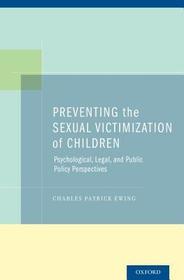
Preventing the Sexual Victimization of Children
Psychological, Legal, and Public Policy Perspectives
- Publisher's listprice GBP 72.00
-
34 398 Ft (32 760 Ft + 5% VAT)
The price is estimated because at the time of ordering we do not know what conversion rates will apply to HUF / product currency when the book arrives. In case HUF is weaker, the price increases slightly, in case HUF is stronger, the price goes lower slightly.
- Discount 10% (cc. 3 440 Ft off)
- Discounted price 30 958 Ft (29 484 Ft + 5% VAT)
Subcribe now and take benefit of a favourable price.
Subscribe
34 398 Ft

Availability
printed on demand
Why don't you give exact delivery time?
Delivery time is estimated on our previous experiences. We give estimations only, because we order from outside Hungary, and the delivery time mainly depends on how quickly the publisher supplies the book. Faster or slower deliveries both happen, but we do our best to supply as quickly as possible.
Product details:
- Publisher OUP USA
- Date of Publication 30 January 2014
- ISBN 9780199895533
- Binding Hardback
- No. of pages288 pages
- Size 160x239x27 mm
- Weight 499 g
- Language English 0
Categories
Short description:
Preventing the Sexual Victimization of Children is the first book to critically evaluate national and international efforts to reduce child sexual abuse and ameliorate its effects.
MoreLong description:
Sexual exploitation of children is a major social problem in the United States and around the world. Depending upon how such exploitation is defined and measured, divergent estimates indicate that in the U.S. between 3 and 37 percent of males, and between 8 and 71 percent of females are sexually abused in some manner during childhood or adolescence. In response, governments have passed strict laws, entered into international treaties, and established large bureaucracies aimed at curbing child sexual abuse.
Preventing the Sexual Victimization of Children is the first book to critically evaluate national and international efforts to reduce child sexual abuse (CSA) and ameliorate its effects. Until now, input from social science and mental health experts has been accepted for the most part uncritically, as have the programs and laws that have been developed in reliance upon that advice. Here Dr. Ewing utilizes empirical data, policy considerations, cost-benefit analyses, psychological theory, legal reasoning, and common sense to undertake the often difficult and sometimes controversial task of distinguishing prevention strategies that are likely to prevent CSA from those that are not. He concludes that the most expensive preventive strategies-such as sex offender registration, enhancing criminal penalties for such offenders, and civilly confining them-are not effective in preventing CSA and may actually increase its likelihood. However, he also concludes that many other strategies are or could be effective in preventing CSA, such as minimizing opportunities for such abuse, risk education, teaching children to protect themselves, encouraging bystander intervention, limiting the cultural sexualization of children, improving the investigation and prosecution of CSA allegations, using technology to stop child pornography and to rescue its victims, changing the culture in child-serving organizations, and more. This volume will be a unique and critical resource for lawyers, researchers, psychologists, social workers, public policy officials, students, and child advocates interested in preventing child sexual abuse.
This well-written book makes an excellent contribution in that it provides an easily digested overview of disparate actions that historically have been treated separately, many of them seldom thought about by professionals focused on their own particular specialization. The author, Charles Patrick Ewing, usefully makes connections among such actions as psychosocial interventions, changes in the law, changes in institutional environments and employment practices, and changes in law enforcement practice - a welcome difference from other books on child sexual victimization.
Table of Contents:
Preface
Acknowledgments
Chapter 1: Introduction and Historical Overview
Chapter 2: The Epidemiology and Effects of Child Sexual Abuse and Exploitation
Chapter 3: Prevention Strategies Aimed at Parents, Children, and the Community
Chapter 4: Prevention Strategies Aimed at Perpetrators and Potential Perpetrators
Chapter 5: Internet-Related Sexual Abuse and Exploitation of Children
Chapter 6: Institutional Child Sexual Abuse
Chapter 7: Prostitution of Minors
Chapter 8: Conclusions
Notes
About the Author
Index

