

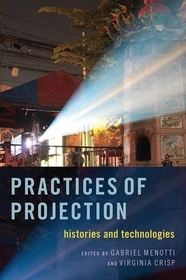
Practices of Projection
Histories and Technologies
- Publisher's listprice GBP 127.50
-
60 913 Ft (58 012 Ft + 5% VAT)
The price is estimated because at the time of ordering we do not know what conversion rates will apply to HUF / product currency when the book arrives. In case HUF is weaker, the price increases slightly, in case HUF is stronger, the price goes lower slightly.
- Discount 10% (cc. 6 091 Ft off)
- Discounted price 54 821 Ft (52 211 Ft + 5% VAT)
Subcribe now and take benefit of a favourable price.
Subscribe
60 913 Ft

Availability
printed on demand
Why don't you give exact delivery time?
Delivery time is estimated on our previous experiences. We give estimations only, because we order from outside Hungary, and the delivery time mainly depends on how quickly the publisher supplies the book. Faster or slower deliveries both happen, but we do our best to supply as quickly as possible.
Product details:
- Publisher OUP USA
- Date of Publication 4 June 2020
- ISBN 9780190934118
- Binding Hardback
- No. of pages300 pages
- Size 160x243x31 mm
- Weight 592 g
- Language English
- Illustrations 52 photographs 26
Categories
Short description:
In Practices of Projection: Histories and Technologies, volume editors Gabriel Menotti and Virginia Crisp address the cultural and technological significance of projection. Throughout the volume, chapters reiterate that projection cannot, and must not, be reduced to its cinematic functions alone.
MoreLong description:
To many, the technological aspects of projection often go unnoticed, only brought to attention during moments of crisis or malfunction. For example, when a movie theater projector falters, the audience suddenly looks toward the back of the theater to see a sign of mechanical failure. The history of cinema similarly shows that the attention to projection has been most focused when the whole medium is hanging in suspension. During Hollywood's economic consolidation in the '30s, projection defined the ways that sync-sound technologies could be deployed within the medium. Most recently, the digitization of cinema repeated this process as technology was reworked to facilitate mobility. These examples show how projection continually speaks to the rearrangement of media technology. Projection therefore needs to be examined as a pivotal element in the future of visual media's technological transition.
In Practices of Projection: Histories and Technologies, volume editors Gabriel Menotti and Virginia Crisp address the cultural and technological significance of projection. Throughout the volume, chapters reiterate that projection cannot, and must not, be reduced to its cinematic functions alone. Borrowing media theorist Siegfried Zielinksi's definition, Menotti and Crisp refer to projection as the "heterogeneous array of artefacts, technical systems, and particularly visual praxes of experimentation and of culture." From this, readers can understand the performative character of the moving image and the labor of the different actors involved in the utterance of the film text. Projection is not the same everywhere, nor equal all the time. Its systems are in permanent interaction with environmental circumstances, neighboring structures, local cultures, and social economies. Thus the idea of projection as a universal, fully autonomous operation cannot hold. Each occurrence of projection adds nuance to a wider understanding of film screening technologies.
At a time when perhaps the central concern of cinema and media studies involves how to approach screen practices as environmental phenomena shaped by shifting technologies, Practices of Projection: Histories and Technologies offers a rich array of perspectives on how such inquiries might proceed. Across the book's fifteen contributions, the until-now undertheorized and underhistoricized technique of projection comes into relief as a vast and differentiated field of creative and technical possibility.
Table of Contents:
1. Situating Projection
Gabriel Menotti Gonring and Virginia Crisp
Part 1. PROJECTION HISTORIES & GEOGRAPHIES
2. A New 'Wild West' of Projection?
Michael Pigott and Richard Wallace
3. The craft of the rural cinema operator: improvised exhibition and the Highlands and Islands Film Guild, Scotland (1946-71)
Ian Goode
4. Solar Powered Cinema and Sustainable Projections
Stefania Haritou
5. Film Projection and the Sacred Geography of Site-Specific Cinema in Contemporary Thailand
Richard MacDonald
Part 2. PROJECTION ELEMENTS & TECHNOLOGIES
6. Six (or seven) ways of looking at a magic lantern slide
Richard Crangle
7. Between Copyright and Creativity: Edison's Kinetoscope and Technological Innovations in Optical Printing
Amanda Egbe
8. '...It's all just a little bit of History repeating': Slide-tape's key works in the UK since the 1970s
Mo White AKA Dr. Mary C White
9. Summoning the Ghosts of Early Cinema and Victorian Entertainment: Kate Moss and "Savage Beauty" at the V&A Museum
Su-Anne Yeo
10. Researching virtual, augmented and mixed realities, or how the Elastic 3D Spaces project emerged from an outdoor projection event
Anthony Head and Leila Sujir
11. They'll take whatever you feed them - reflections on projection in live audiovisual performance
Cornelia Lund
Part 3. PROJECTION AS KNOWLEDGE & INTERPRETATION
12. CASTING - investigation of projection mapping's spatiality in a continuum of projected moving-image art
Yiyun Kang
13. Projection between exhibition and information: experimental and artists' film at Sonsbeek 71
Adeena Mey
14. Bark and Butterflies: Projection, Post-Memory and Phantasmagoria
Adrian Palka
15. Imagistic Projection as Relational Becoming
Andréia Machado Oliveira & Felix Rebolledo Palazuelos

