

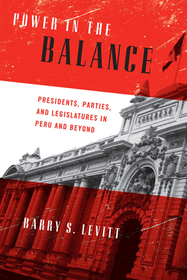
Power in the Balance
Presidents, Parties, and Legislatures in Peru and Beyond
Series: Kellogg Institute Series on Democracy and Development;
- Publisher's listprice GBP 28.99
-
13 849 Ft (13 190 Ft + 5% VAT)
The price is estimated because at the time of ordering we do not know what conversion rates will apply to HUF / product currency when the book arrives. In case HUF is weaker, the price increases slightly, in case HUF is stronger, the price goes lower slightly.
- Discount 10% (cc. 1 385 Ft off)
- Discounted price 12 465 Ft (11 871 Ft + 5% VAT)
Subcribe now and take benefit of a favourable price.
Subscribe
13 849 Ft

Availability
Estimated delivery time: In stock at the publisher, but not at Prospero's office. Delivery time approx. 3-5 weeks.
Not in stock at Prospero.
Why don't you give exact delivery time?
Delivery time is estimated on our previous experiences. We give estimations only, because we order from outside Hungary, and the delivery time mainly depends on how quickly the publisher supplies the book. Faster or slower deliveries both happen, but we do our best to supply as quickly as possible.
Product details:
- Publisher University of Notre Dame Press
- Date of Publication 30 January 2012
- Number of Volumes Print PDF
- ISBN 9780268034139
- Binding Paperback
- No. of pages358 pages
- Size 229x152x19 mm
- Weight 481 g
- Language English
- Illustrations 18 tables and 4 halftones - 4 Halftones, unspecified - 18 Tables, unspecified Halftones, unspecified 0
Categories
Long description:
"
In Power in the Balance: Presidents, Parties, and Legislatures in Peru and Beyond, Barry S. Levitt answers urgent questions about executive power in ""new"" democracies. He examines in rich detail the case of Peru, from President Alan García's first term (1985–1990), to the erosion of democracy under President Alberto Fujimori (1990–2000), through the interim government of Valentín Paniagua (2000–2001) and the remarkable, if rocky, renewal of democracy culminating in Alejandro Toledo's 2001–2006 presidency. This turbulent experience with democracy brings into clear focus the functioning of formal political institutions—constitutions and electoral laws, presidents and legislatures, political parties and leaders—while also exposing the informal side of Peru's national politics over the course of two decades.
Levitt's study of politics in Peru also provides a test case for his regional analysis of cross-national differences and change over time in presidential power across eighteen Latin American countries. In Peru and throughout Latin America, Levitt shows, the rule of law itself and the organizational forms of political parties have a stronger impact on legislative-executive relations than do most of the institutional traits and constitutional powers that configure the formal ""rules of the game"" for high politics. His findings, and their implications for improving the quality of new democracies everywhere, will surprise promoters, practitioners, and scholars of democratic politics alike.
" More
