

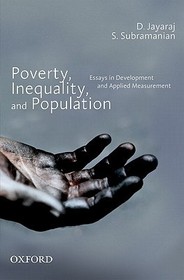
Poverty, Inequality, and Population
Essays in Development and Applied Measurement
- Publisher's listprice GBP 30.00
-
13 545 Ft (12 900 Ft + 5% VAT)
The price is estimated because at the time of ordering we do not know what conversion rates will apply to HUF / product currency when the book arrives. In case HUF is weaker, the price increases slightly, in case HUF is stronger, the price goes lower slightly.
- Discount 10% (cc. 1 355 Ft off)
- Discounted price 12 191 Ft (11 610 Ft + 5% VAT)
Subcribe now and take benefit of a favourable price.
Subscribe
13 545 Ft

Availability
Uncertain availability. Please turn to our customer service.
Why don't you give exact delivery time?
Delivery time is estimated on our previous experiences. We give estimations only, because we order from outside Hungary, and the delivery time mainly depends on how quickly the publisher supplies the book. Faster or slower deliveries both happen, but we do our best to supply as quickly as possible.
Product details:
- Publisher OUP India
- Date of Publication 30 September 2010
- ISBN 9780198067948
- Binding Hardback
- No. of pages266 pages
- Size 220x149x27 mm
- Weight 534 g
- Language English 0
Categories
Short description:
In the assessment of a society's process of development, socioeconomic indicators such as poverty and discrimination, inequality, child labour, age and sex composition etc. need to be explored through rigorous measurement and careful analysis. This volume addresses both the formal elements of measurement as well as applications of these concerns in addressing the various dimensions of development.
MoreLong description:
The subjects of poverty, inequality, and population are integral to the study of human development. Poverty and taxation, distribution of wealth and deprivation, the nexus between poverty and child labour, age- and sex-composition of the population are all significant questions that demand both rigorous measurement and careful analysis in the assessment of a society's process of development. The ability to obtain meaningful answers to these questions is frequently determined by the
ability to measure the categories of poverty, inequality and population. What is required is both conceptual clarity and empirical relevance. This combination of the formal elements of measurement and the substantive elements of development is a key feature of this book.
Table of Contents:
Acknowledgements; Introduction;
Out of School and (Probably) in Work: Child Labour and Capability Deprivation in India;
Poverty Eradication Through Redistributive Taxation: Some Elementary Considerations;
. Poverty and Discrimination: Measurement and Evidence from Rural India;
. Horizontal and Vertical Inequality: Some Interconnections and Indicators;
. The Distribution of Household Wealth in India;
Comparing the Age Structures of Populations;
Assessing the 'Agedness' of a Population;
Assessing the 'Femaleness' of a Population;
Women's Well-being and the Sex Ratio at Birth: Some Suggestive Evidence from India;
The Well-being Implications of a Change in the Sex Ratio of a Population;
. Manufacturing Hysteria: On Census-inspired 'Nationalism';
Abusing Demography;
Bibliography.

