

- Publisher's listprice GBP 36.99
-
16 700 Ft (15 905 Ft + 5% VAT)
The price is estimated because at the time of ordering we do not know what conversion rates will apply to HUF / product currency when the book arrives. In case HUF is weaker, the price increases slightly, in case HUF is stronger, the price goes lower slightly.
- Discount 10% (cc. 1 670 Ft off)
- Discounted price 15 030 Ft (14 315 Ft + 5% VAT)
Subcribe now and take benefit of a favourable price.
Subscribe
16 700 Ft

Availability
printed on demand
Why don't you give exact delivery time?
Delivery time is estimated on our previous experiences. We give estimations only, because we order from outside Hungary, and the delivery time mainly depends on how quickly the publisher supplies the book. Faster or slower deliveries both happen, but we do our best to supply as quickly as possible.
Product details:
- Publisher OUP USA
- Date of Publication 15 November 2022
- ISBN 9780197548523
- Binding Paperback
- No. of pages208 pages
- Size 252x177x11 mm
- Weight 381 g
- Language English 254
Categories
Short description:
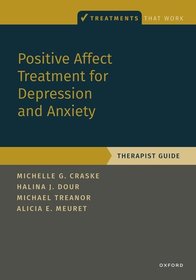
Positive Affect Treatment for Depression and Anxiety: Therapist Guide is a modular manual presenting a unified treatment approach for depression, anxiety and anhedonia, designed to help individuals regain interest and enjoyment in their usual activities while improving their quality of life.
MoreLong description:
Anhedonia is a risk factor for poor prognosis and suicidality, and yet treatments to date have been relatively ineffective for anhedonia. Based on advances in behavioral and neural science, Positive Affect Treatment was developed to specifically target areas of reward sensitivity that are believed to contribute to anhedonia. These include the anticipation and motivation for reward, the response to attainment of reward, and the learning of associations between actions and reward outcomes.
Positive Affect Treatment for Depression and Anxiety: Therapist Guide is intended to be used by clinicians who are familiar with cognitive-behavioral therapy (CBT) generally and with clinical presentation of depression, anxiety and anhedonia. Results show that Positive Affect Treatment not only improves positive mood state but also decreases depression and anxiety. This guide will be an indispensable resource for all practitioners who wish to effectively and efficiently help individuals regain interest and enjoyment in their usual activities while improving their quality of life.
Anhedonia is one of the two cardinal symptoms of depression and existing treatments either pharmacological or psychotherapeutic are better at normalizing negative affect than elevating positive affect. The authors of Positive Affect Treatment for Depression and Anxiety have succeeded in doing what nobody else has done in helping patients regain a sense of joy and wellbeing in life. This could be a gamechanger. - Steven D. Hollon, Ph.D., Gertrude Conaway Vanderbilt Professor of Psychology, Vanderbilt University
Table of Contents:
Module 1: Psychoeducation
Chapter 1: Introductory Information for Therapists
Chapter 2: Behavioral Science and Neuroscience Identify Targets for Treatment of Anhedonia
Chapter 3: General Treatment Format and Guiding Therapy Principles
Chapter 4: Psychoeducation
Module 2: Treatment Skill Sets
Chapter 5: Actions Toward Feeling Better
Chapter 6: Attending to the Positive
Chapter 7: Building Positivity
Module 3: Treatment Gains and Relapse Prevention
Chapter 8: Continuing the Journey After Treatment
Appendix: Client Exercises
Recommended Readings
References
About the Authors

